D2 Survivors Necromancer Build: Skills, Trees and Card Order
Updated 2026-11-02
Version build 20261101.1
The D2 Survivors Necromancer build deals its damage from one skill and the passives that evolve it: Teeth from Poison and Bone, or Raise Skeleton from Summoning, with curses on top. This page covers the first card, all 30 tree rows, both leveling routes and the mistakes that stall a run.
What does a D2 Survivors Necromancer build look like at a glance?
A D2 Survivors Necromancer build is a spell caster that fights behind summons: Poison and Bone or Summoning carries the damage, Curses make the pack easier to kill, and Energy feeds all of it at 1.5% a point. The table below is the whole class on one screen, and every number comes from the original wiki.
Class — Necromancer, one of the seven Diablo II classes the project ships.
Role — bone, poison, curses and the raised dead, the wiki's own summary.
Trees — Curses, Poison and Bone Skills and Summoning Skills, ten rows each.
Rows — 30 in all: 13 skills, 11 evolutions and 6 passives.
Caps — skill 8, evolution 1, passive 5, and nothing passes your character level minus its required level plus one.
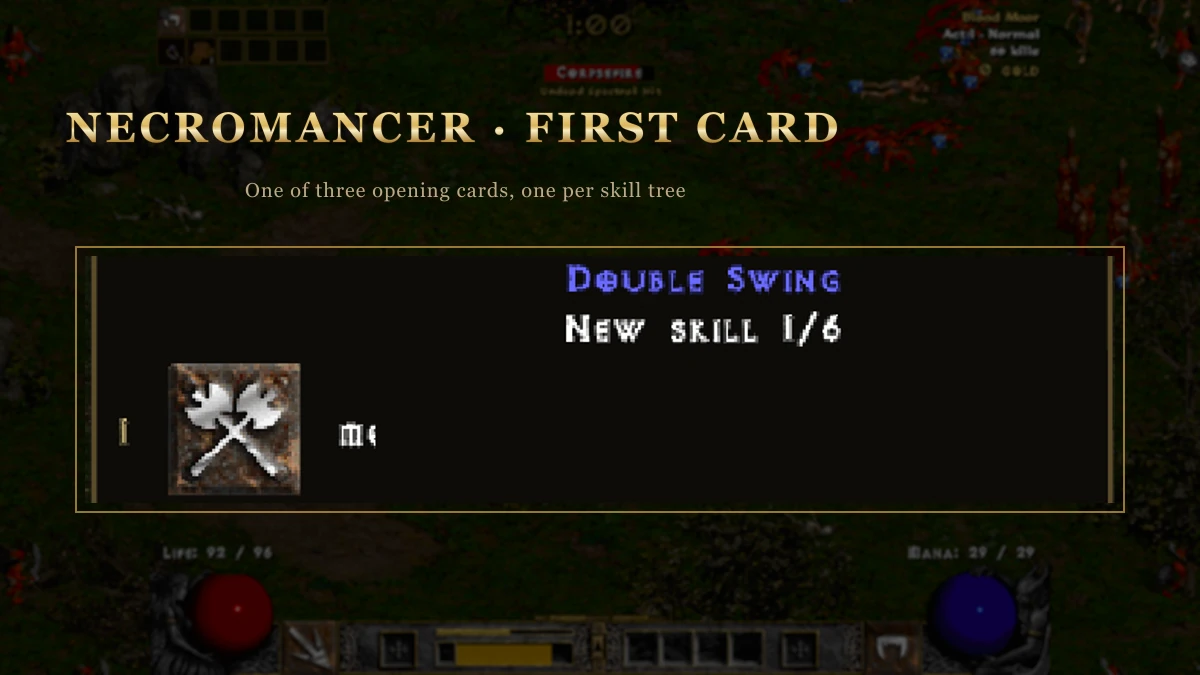
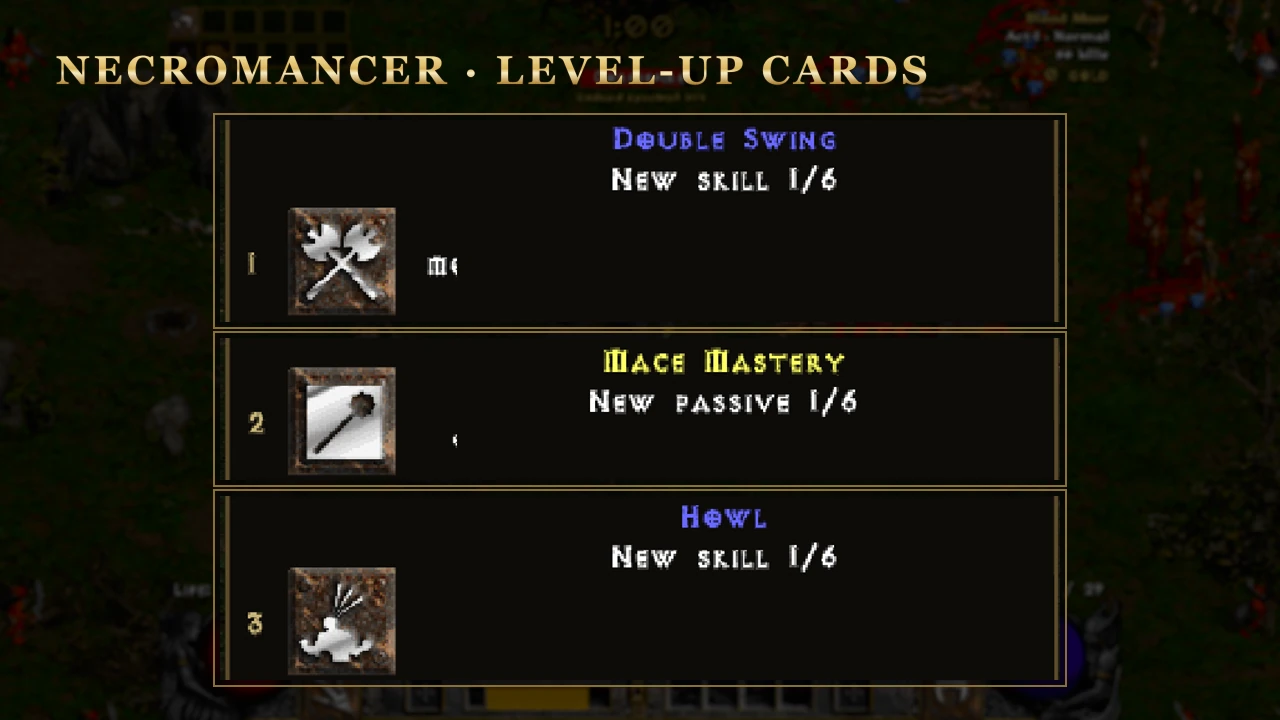
First card — one level-1 skill per tree: Amplify Damage, Teeth, Raise Skeleton.
Damage stat — Energy, 1.5% a point on spells, summons and Corpse Explosion.
Key passives — Skeleton Mastery at +20% life and damage a level, and Bone Wall, which raises the magic skills twice.
First evolution — Teeth into Bone Spear, with Bone Wall held, from character level 18.
Read next on this site:
- All seven classes, side by side
- Keys, the level-up screen and a first run
- Where the developer's own download page is
- What to do when the game frame will not load
- What the fan project actually is
This is an unofficial fan page for D2 Survivors, a fan-made browser take on Diablo II. It is not affiliated with, endorsed by or approved by Blizzard Entertainment, and the game's art and audio belong to Blizzard.
How does a D2 Survivors Necromancer build play?
A D2 Survivors Necromancer build never presses a skill: every skill casts on its own recharge, so the only input is where you stand. Poison and Bone hits from range, Summoning puts bodies between you and the pack, and curses change what the pack does without dealing damage.
Energy is the class's damage stat: each point adds 1.5% to his spells, his summons and Corpse Explosion, where every other class gets 1% a point. Poison Dagger's stab is the exception, being physical, so Strength raises it; Bone Wall raises the magic skills on top of that.
Curses deal no damage. They weaken monsters, turn them or hold them, and the cards offer each one 40% as often as the class's other skills. Unlike Diablo II, different curses sit on one monster at once, and Amplify Damage and Decrepify are one line, so either replaces the other.
Summoning Skills are spells too, so Energy raises every summon's blow. Skeletons and mages rise from a fresh corpse when there is one in reach and from the ground when there is not, golems need no corpse, and any skill that uses a corpse takes it. His life is the median class's, 4 a level and 6 a point of Vitality, so he survives on what stands in front of him.
What should you pick first on a Necromancer?
A D2 Survivors Necromancer build starts with the level-1 damage skill from the tree you mean to carry, and that skill goes to 8 before its catalyst appears. Everything else, chests, banishes and a second skill, only matters after that first skill reaches level 8 and its evolution.
1. Take Teeth or Raise Skeleton from the first card — the hand offers one level-1 skill per tree, Amplify Damage, Teeth and Raise Skeleton, and only the last two deal damage themselves.
2. Put every level into that skill until it caps — a skill cannot pass your character level minus its required level plus one, so a level-1 skill is finished by character level 8.
3. Take the catalyst passive as soon as it appears — Teeth evolves with Bone Wall and Raise Skeleton with Skeleton Mastery, and a skill evolves only while you hold its catalyst.
4. Pass on a second damage skill — a Normal run holds a fixed number of skill slots and every skill needs its own levels, so two projects reach neither cap.
5. Open every chest — an evolution never arrives as a level-up card, and the chest that evolves a ready skill holds nothing but gold.
6. Banish nothing the build still needs — a banished card stays out until the run goes past Baal, and a banished catalyst locks its skill out of evolving until then.
Which Necromancer curses earn a slot in D2 Survivors?
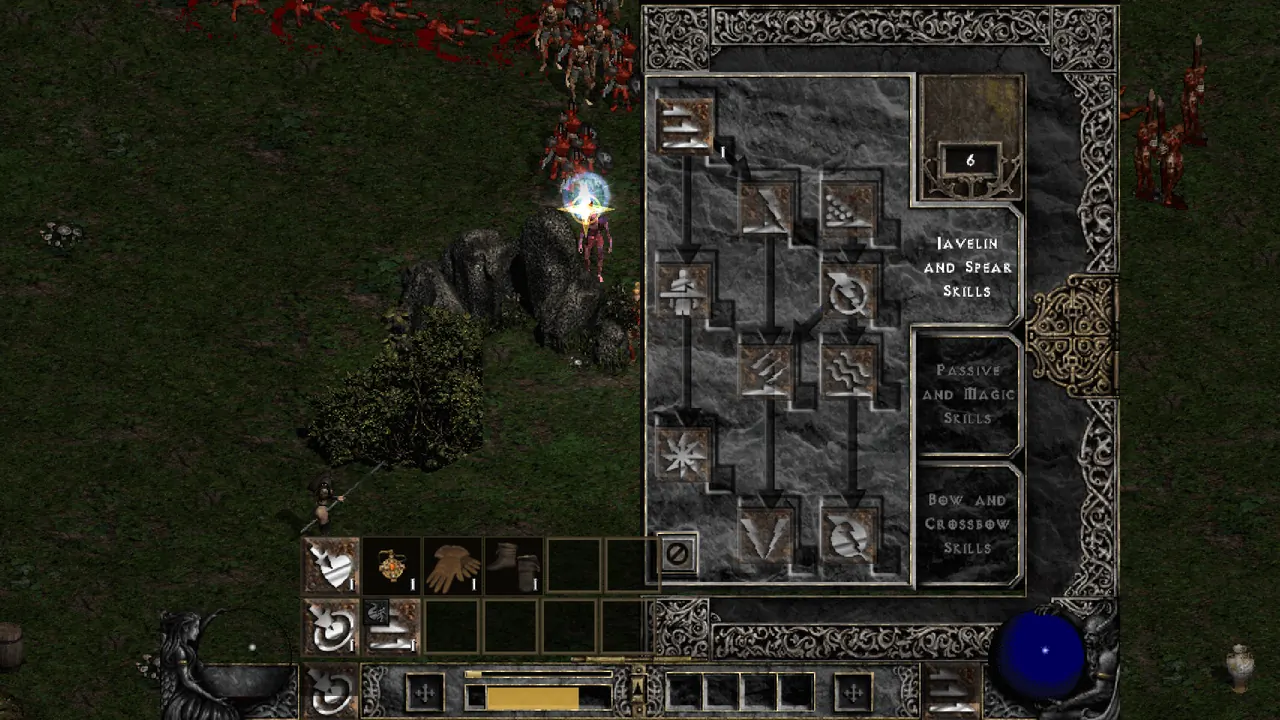
Curses hold a pack, they do not clear it, and a D2 Survivors Necromancer build brings one so its damage lands. Amplify Damage is the one that changes damage: it removes 100% of a monster's physical resistance, which doubles what your summons and Corpse Explosion deal.
Amplify Damage — required level 1, max level 8, skill.
Dim Vision — required level 6, max level 8, skill.
Weaken — required level 6, max level 8, skill.
Iron Maiden — required level 12, max level 8, skill.
Terror — required level 12, max level 8, skill.
Confuse — required level 18, max level 1, evolution.
Life Tap — required level 18, max level 8, skill.
Attract — required level 24, max level 1, evolution.
Decrepify — required level 24, max level 1, evolution.
Lower Resist — required level 30, max level 5, passive.
Two rules decide the tree. Amplify Damage and Decrepify are one line, so either replaces the other, and of the four curses that steer a monster only one sets its direction at a time, in the order Terror, Dim Vision, Attract, Confuse. Those four last half as long on Nightmare and a quarter as long in Hell, and Terror, Dim Vision and Confuse never take an act boss.
For a D2 Survivors Necromancer build, each cast goes for the nearest pack that does not have that curse yet, so casting it again spreads it instead of renewing the same monsters. Amplify Damage, Weaken and Decrepify go for an act boss first, and a curse's recharge stays its own level's whatever +skills you wear.
Which Poison and Bone skills carry a Necromancer run?
Poison and Bone is where a D2 Survivors Necromancer build gets its damage, and it opens at level 1 with Teeth and the Bone Armor passive. Teeth fires a fan of teeth at the nearest monster, Bone Wall makes that fan stronger, and Corpse Explosion turns the pack's own dead into the follow-up.
Teeth — required level 1, max level 8, skill.
Bone Armor — required level 1, max level 5, passive.
Corpse Explosion — required level 6, max level 8, skill.
Poison Dagger — required level 6, max level 8, skill.
Bone Wall — required level 12, max level 5, passive.
Bone Spear — required level 18, max level 1, evolution.
Poison Explosion — required level 18, max level 1, evolution.
Bone Prison — required level 24, max level 8, skill.
Bone Spirit — required level 30, max level 1, evolution.
Poison Nova — required level 30, max level 1, evolution.
Teeth is the cheapest opener in the class: 4 teeth of 14 damage at level 1, 21 teeth of 25 damage at level 8, each stopping at the first monster it touches. Bone Wall raises it twice, once through the magic damage it adds and once through its synergy, which is why the passive earns a slot before the evolution.
Bone Armor is always on, and it is damage reduction rather than a button: 17% less physical damage at level 1 and 33% at level 5, with a bone pool of 100 and 420 that regrows in 30 seconds. The pool takes every physical hit before your life and adds 30 for each Diablo II level of Bone Wall and Bone Prison learned.
Corpse Explosion deals 70% to 120% of the dead monster's own Diablo II life within 80 at level 1 and 216 at level 8, and Energy raises the whole blast. A fire immune monster still takes its physical half, and Amplify Damage raises that half.
What do Summoning Skills add to a Necromancer build?
Summoning Skills put bodies on the field: skeletons, skeletal mages, a golem and revived monsters. Raise Skeleton and its catalyst Skeleton Mastery both open at level 1, so a D2 Survivors Necromancer build can have an army before its first act boss.
Raise Skeleton — required level 1, max level 8, skill.
Skeleton Mastery — required level 1, max level 5, passive.
Clay Golem — required level 6, max level 8, skill.
Raise Skeletal Mage — required level 12, max level 8, skill.
Golem Mastery — required level 12, max level 5, passive.
Blood Golem — required level 18, max level 1, evolution.
Iron Golem — required level 24, max level 1, evolution.
Summon Resist — required level 24, max level 5, passive.
Fire Golem — required level 30, max level 1, evolution.
Revive — required level 30, max level 1, evolution.
Raise Skeleton grows from 3 skeletons of 53 life and 13 damage at level 1 to 8 of 270 life and 89 damage at level 8, and Skeleton Mastery adds 20% life and damage a level, 100% at level 5. Mastery covers mages and the skeletons Revive raises too, but not golems, where Golem Mastery is the passive that adds life.
For a D2 Survivors Necromancer build, gear's +skills raise what a summon deals, not how many come or how much life they have, and summons have more life on Nightmare and more again in Hell. Skeletons, mages and golems all go for the act boss whenever he is near you, which is what makes the army worth its slots.
How do Necromancer evolutions work, in order?
A D2 Survivors Necromancer build evolves a skill only when it sits at its max level, its catalyst passive is among the ones you hold, and your character level has reached both the evolution's required level and the catalyst's. The next chest you open does it, and that chest holds nothing but gold.
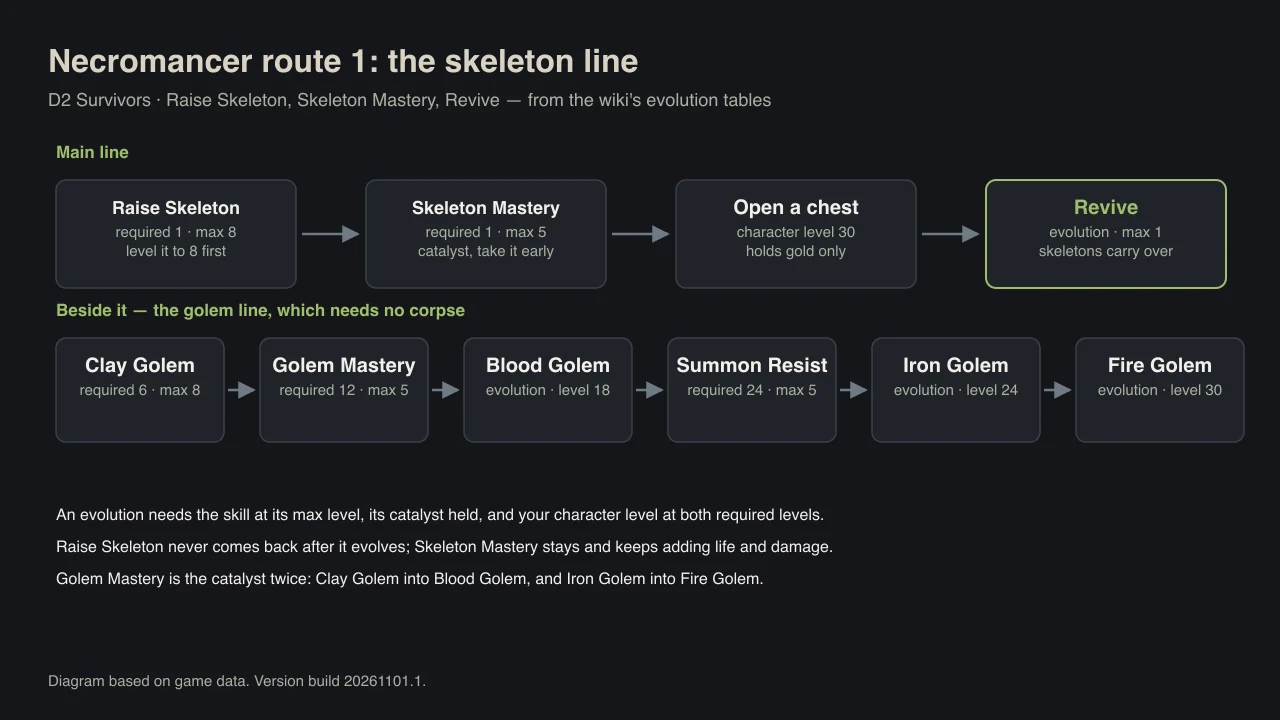
The chains, base first and catalyst in the middle: Teeth, Bone Wall, Bone Spear, Bone Armor, Bone Spirit. Poison Dagger, Faster Cast Rate, Poison Explosion, Lower Resist, Poison Nova. Amplify Damage, Faster Run/Walk, Decrepify. Dim Vision, Telekinesis, Confuse, Vitality, Attract. Raise Skeleton, Skeleton Mastery, Revive. Clay Golem, Golem Mastery, Blood Golem, Summon Resist, Iron Golem, Golem Mastery, Fire Golem.
Route one is the skeleton line and the shortest in the class: Raise Skeleton to 8, Skeleton Mastery to 5, then the chest that evolves Raise Skeleton into Revive once your character level reaches 30. Clay Golem and Golem Mastery can run beside it, because golems need no corpse and the mastery adds their life.
Most bases come back to the cards after they evolve as a new level-1 skill, but a base whose evolution carries what it does never does: Amplify Damage, Dim Vision, Raise Skeleton and Clay Golem here. A base held beside its own evolution never evolves either, which is why the line asks for one Raise Skeleton rather than two, and one skill evolves a chest, so two ready skills take two chests.
Which Necromancer leveling route should you take?
Two routes carry a D2 Survivors Necromancer build through Normal: Raise Skeleton with Skeleton Mastery, or Teeth with Bone Wall. The skeleton route keeps monsters off you, while the bone route kills from range and adds Corpse Explosion to clear a screen it has already thinned.
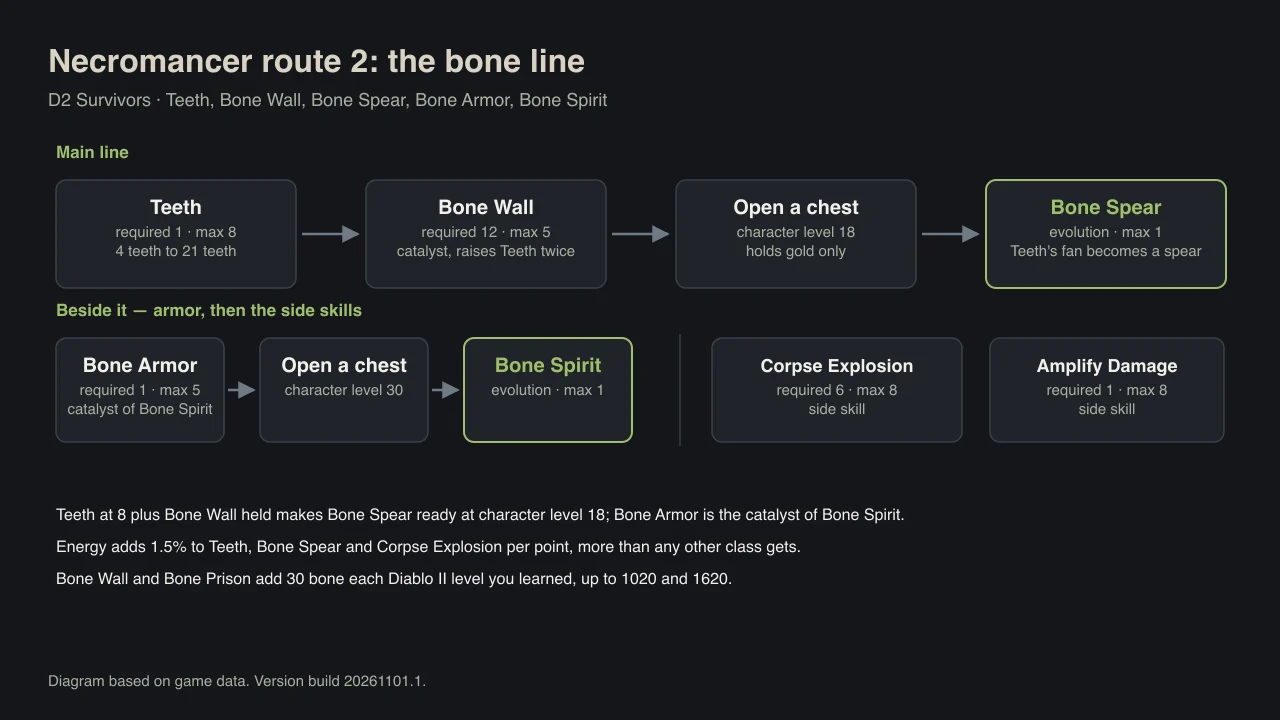
1. Teeth to 8 first — the fan widens as the tooth count grows, so those first levels are the biggest jump the route gets.
2. Bone Wall as soon as it opens at 12 — it raises Teeth through its magic damage and its synergy at once, and it is the catalyst the evolution needs.
3. The first chest after character level 18 — the earliest point where Teeth at 8, Bone Wall held and your level line up for Bone Spear.
4. Bone Armor to 5 while you wait for 30 — it adds damage reduction and a bone pool that grows with every Bone Wall level you have learned.
5. Bone Spirit at 30 — Bone Armor is its catalyst, so a second passive slot has to stay free for it.
6. Corpse Explosion as the second skill — it needs a corpse, and by then the Teeth fan has usually made several.
Once every skill slot is full, a card can offer one late skill of a tree in place of an early skill of the same tree, keeping the old levels as far as the new required level allows. When fewer than three cards are open, the hand fills with stat points and +1 to a tree you hold a skill on, at most 3 a tree a run.
What mistakes stall a D2 Survivors Necromancer run?
Most D2 Survivors Necromancer build runs stall in the same three places: levels spread over three trees, a catalyst taken after a second skill, and a banish spent on a card the build still needed. Each of those costs a whole act of levels, because a skill that cannot reach its cap cannot evolve.
Building all three trees at once. A Normal run holds a fixed number of skill slots and every skill needs its own levels, so a build that spreads out evolves nothing.
Taking a second damage skill before the catalyst. The cards that lead to an evolution come more often than the rest, so the catalyst arrives soon enough, and a second skill only splits the levels.
Banishing the next level of a skill you already hold, which ends every level card that skill had. A banished catalyst cannot be taken at all, so its skill cannot evolve until the run goes past Baal.
Casting Corpse Explosion on every corpse in reach. Any skill that uses a corpse takes it, so the skeletons you meant to raise will not rise from that body.
Building Amplify Damage and Decrepify as two curses, or treating Bone Armor as a button. Those two are one line, and Bone Armor is a passive that is always on.
Related guides
D2 Survivors Necromancer FAQ
What is the best D2 Survivors Necromancer build to start a run with?
Raise Skeleton with Skeleton Mastery. Both open at level 1, the mastery gives skeletons, mages and revives 20% life and damage a level, and an army keeps monsters off a class that gains only 4 life a level. Teeth with Bone Wall is the alternative for casting from range.
Which Necromancer tree should I level first?
The tree whose level-1 damage skill you took from the first card. Poison and Bone offers Teeth and Summoning offers Raise Skeleton, and a level-1 skill reaches its 8-level cap by character level 8, so the first card decides the route.
Do curses deal damage in D2 Survivors?
No. They weaken monsters, turn them or hold them, and each is offered on the cards 40% as often as the class's other skills. Amplify Damage is the exception in effect, removing 100% of a monster's physical resistance for 4 seconds at level 1 and doubling physical damage.
How many skills and passives can a Necromancer hold?
The wiki states the rule rather than a headline count: going on past Baal adds 2 skill slots and 2 passive slots, and their picks arrive at once as cards, while a fresh run on Nightmare or Hell starts with them. A full build can then trade an early skill of a tree for a late one.
How do Necromancer skills evolve?
A skill evolves when it is at its max level, you hold its catalyst passive and your character level has reached both its required level and the catalyst's. The next chest you open does it and holds nothing but gold. Teeth needs Bone Wall and level 18, Raise Skeleton needs Skeleton Mastery and level 30.
Does Amplify Damage stack with Decrepify?
No. They are one line, so either replaces the other on a monster. Different curses do stack, so a D2 Survivors Necromancer build keeps Weaken or Life Tap beside Amplify Damage, and each new cast goes for the nearest pack that lacks that curse.
Is Bone Armor a button I have to press?
No. In this game Bone Armor is a passive that is always on: 17% less physical damage at level 1 and 33% at level 5, with a bone pool of 100 to 420 that absorbs physical hits before your life and regrows in 30 seconds. Elemental and magic damage pass it by.