D2 Survivors Wiki: Game Reference Guide
Updated 2026-11-07
Version build 20261101.1
The D2 Survivors wiki is a player reference for understanding the game’s systems and finding details when you need them. It covers getting started, character growth, skills, items, monsters, difficulties, quests, and more. Use it to look up a rule or follow a topic from the camp through a run.
What Does the D2 Survivors Wiki Cover?
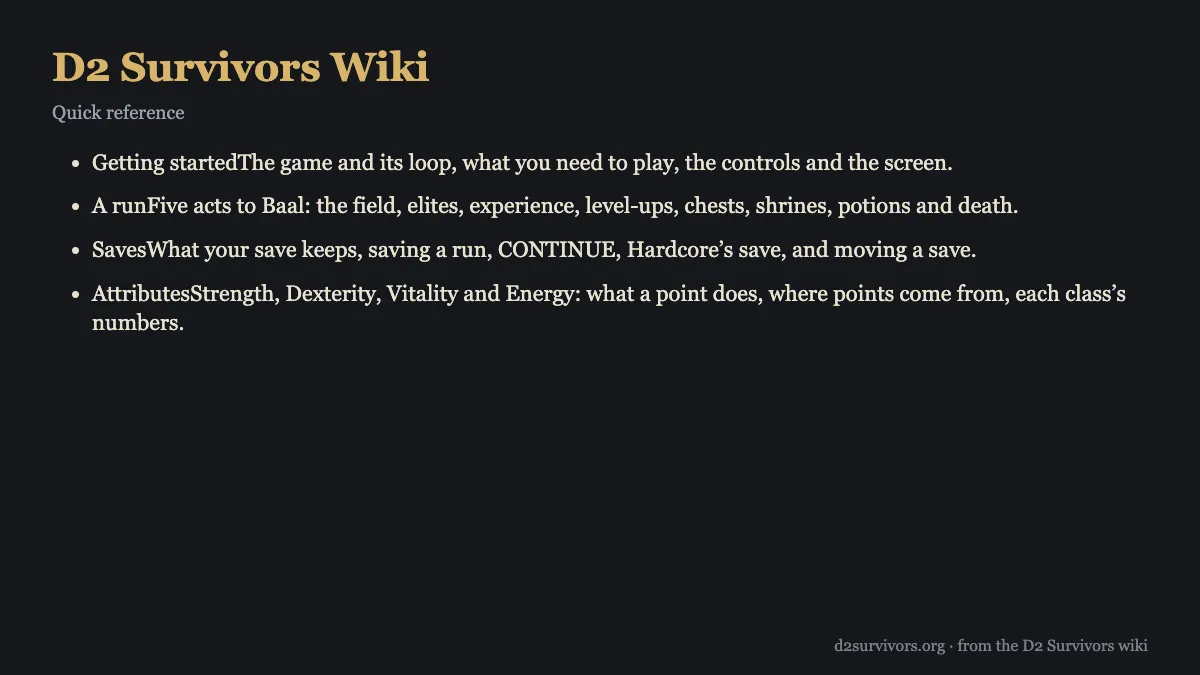
The D2 Survivors wiki covers the path from starting a game to Hell’s endgame. Getting started explains the loop, controls, and screen; A run follows the five acts to Baal. Other guides cover saves, character stats, damage, camp services, quests, mercenaries, Hardcore, and Ladder rules. Look up a rule or see how it fits into a run.
Browse the class pages and build guides for class overviews and build paths. Attributes explains Strength, Dexterity, Vitality, and Energy; Stats and Damage describe character screen values and how hits are dealt or reduced.
The camp has its own guide to the people and services available between runs, including what each person sells or does and the price. Quests follows Deckard Cain’s tasks and rewards, including the Search for Cain and the Shattered Light. For a compact lookup, Key numbers gathers the game’s main numbers and points to the page that explains each one; the Glossary lists game terms alphabetically.
| Field | Value |
|---|---|
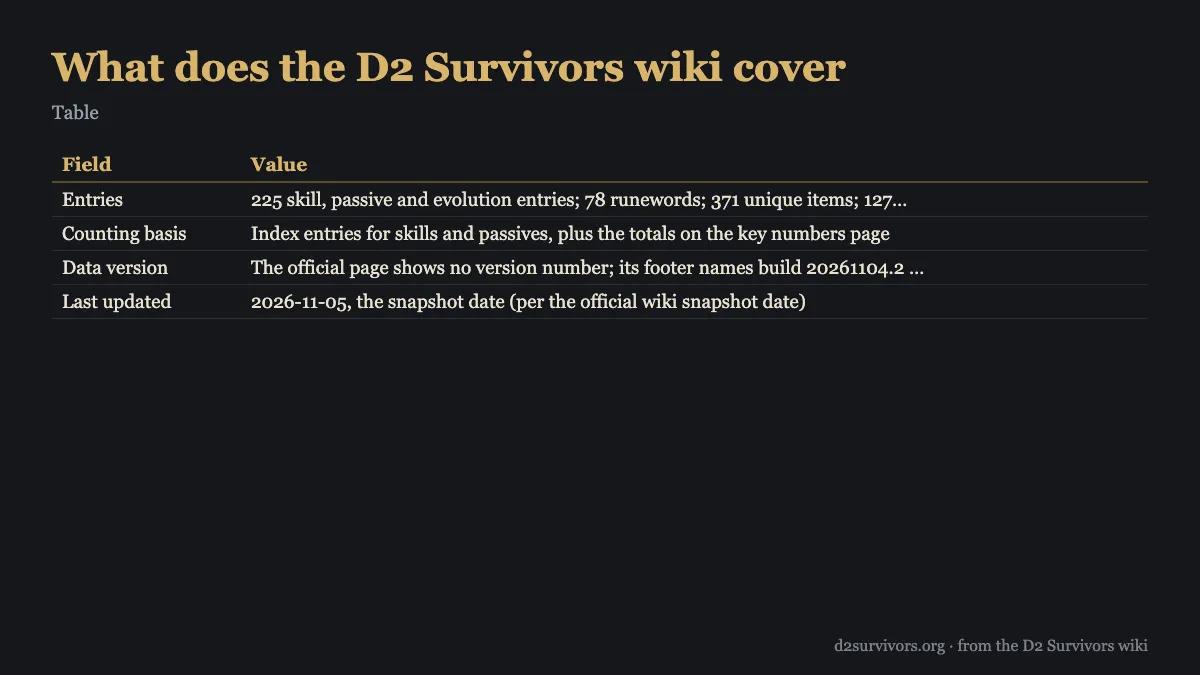
| Entries | 225 skill, passive and evolution entries; 78 runewords; 371 unique items; 127 set items |
| Counting basis | Index entries for skills and passives, plus the totals on the key numbers page |
| Data version | The official page shows no version number; its footer names build 20261104.2 · 2b44548b |
| Last updated | 2026-11-05, the snapshot date (per the official wiki snapshot date) |
Where Are the Class Skill Lists?
Skills lists every class’s skills, passives, evolutions, and modifiers. Skill systems explains shared rules for cards, levels, synergies, +skills, item skills, and recharge. Visit the class builds to connect class details with build choices.
Skills cast automatically, each on its own recharge. Faster Cast Rate shortens spell recharge; Increased Attack Speed shortens weapon attacks. A run holds 6 skills and 6 passives on Normal, 8 of each on Nightmare, and 10 on Hell. Skills open at their required level, then each further level requires one more character level.
To evolve a skill, reach its max level, hold its catalyst passive, and meet the required levels. The next chest evolves one ready skill; evolutions never come from level-up cards. Usually, the base returns as a new level 1 skill in its own slot. Bases whose evolutions carry their armor, curse, or form do not return.
Level-up cards can offer a skill or passive, another level, or—when fewer than three cards are open—a stat point or +1 to a tree. Cards that lead to evolutions appear more often, and free passive slots are held for needed catalysts. Banish removes a card until the run continues past Baal; going on adds 2 skill and 2 passive slots with picks offered at once.
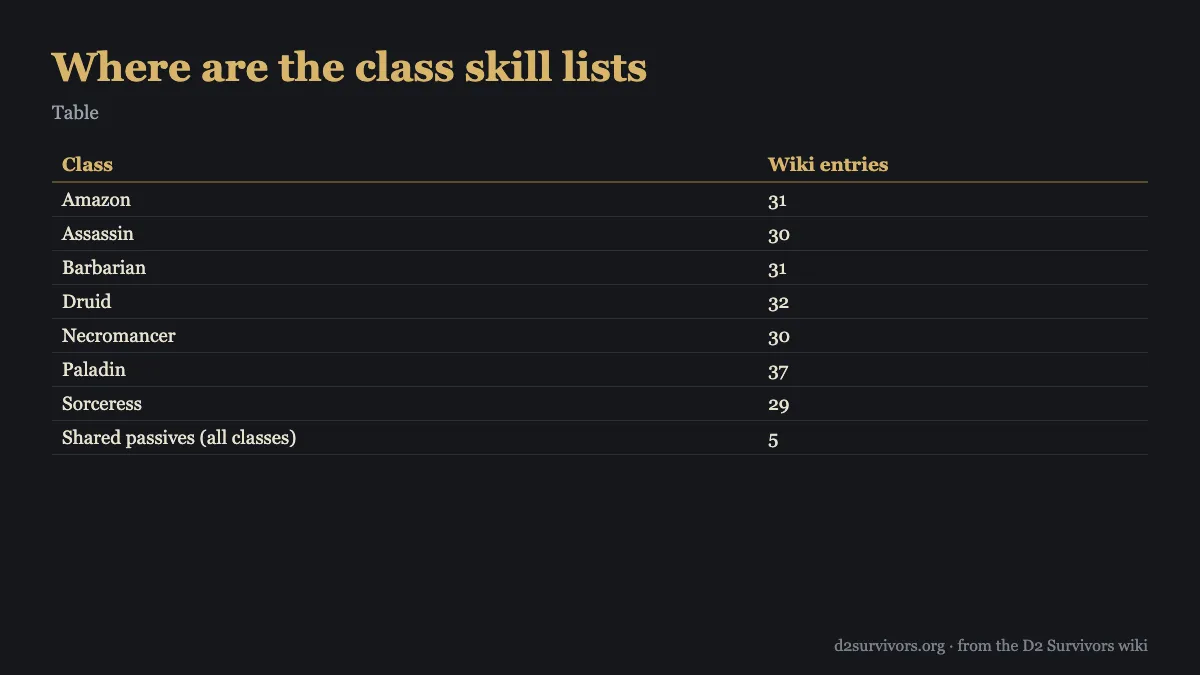
| Class | Wiki entries |
|---|---|
| Amazon | 31 |
| Assassin | 30 |
| Barbarian | 31 |
| Druid | 32 |
| Necromancer | 30 |
| Paladin | 37 |
| Sorceress | 29 |
| Shared passives (all classes) | 5 |
| Total | 225 |
Where Are Runewords, Uniques and Sets in the D2 Survivors Wiki?
Runewords lists every runeword, its runes and properties, and explains how they drop. Uniques shows each unique’s picture and item box; Sets lists pieces and bonuses. The D2 Survivors wiki groups these with Items, which covers rarities, drops, item levels, Magic Find, charms, the stash, and the loot filter.
Items covers gear categories. Charsi’s Forge explains Temper, Clean, the Hellforge, and Upgrade with the Burning Essence of Terror. Find the runeword reference at Runewords.
The camp guide covers the Rogue Encampment’s people, services, and prices. Saves explains what a save keeps, saving a run, CONTINUE, Hardcore saves, and moving a save. Use these pages to check gear and progress between runs.
Check a skill list alongside gear that depends on skills. +skills can come from items, a Skill Shrine, Cain’s Horadric Scroll, or Battle Command; a tree bonus raises its held skills and passives. You can move a skill modifier point to another skill or option from the skill window.
Where Are Monsters, Bosses and Difficulties?
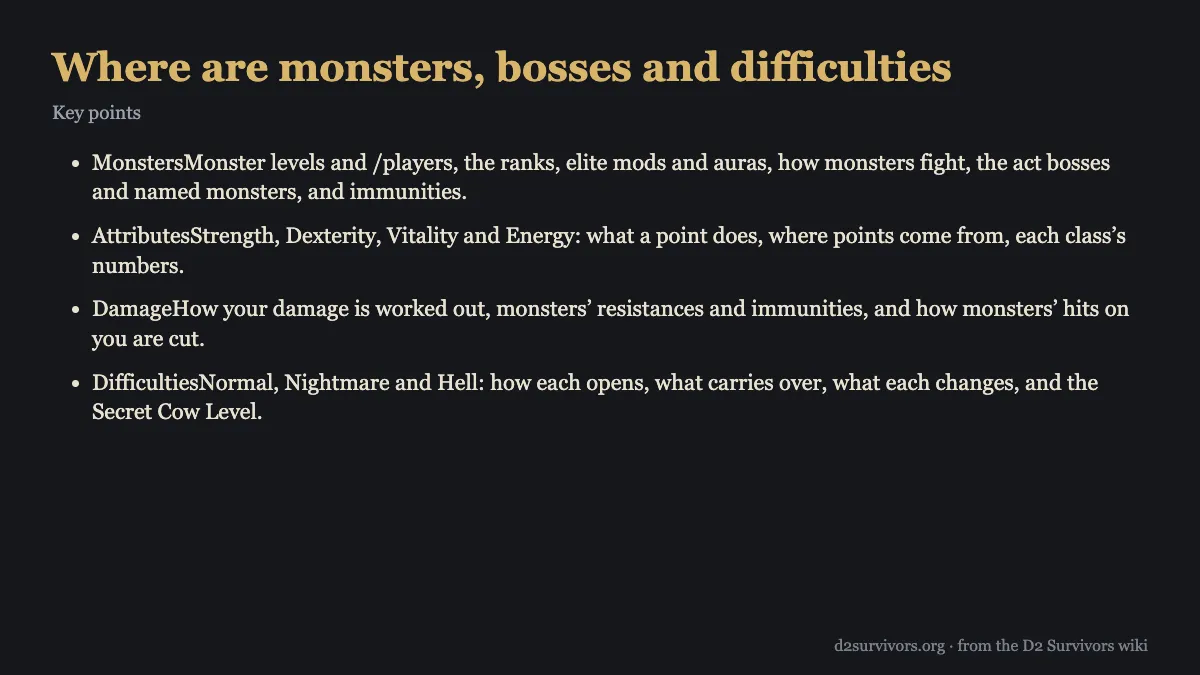
Monsters covers levels, /players, ranks, elite mods and auras, combat, immunities, bosses, and named monsters. Difficulties explains how Normal, Nightmare, and Hell open and change, including the Secret Cow Level. Terror tiers covers Hell’s waves, timed boss, and endless climb.
Nightmare and Hell numbers describe runs with a banked hero. If the difficulty is open but no banked hero exists, a new level 1 hero climbs to /players 6 over each act, and act bosses have 3× their life. Rank prices rise at each step; see the camp guide. A rank marked Yes can continue 999 past its maximum, with each rank worth less.
The ubers guide covers the Diablo Clone, Annihilus, keys, the Pandemonium levels, Uber Tristram, and the Hellfire Torch. Hardcore explains its one-life rules, save, camp, graveyard, death, and Ladder boards. Ladder rules covers rankings, run submissions, and what to do when a run does not count.
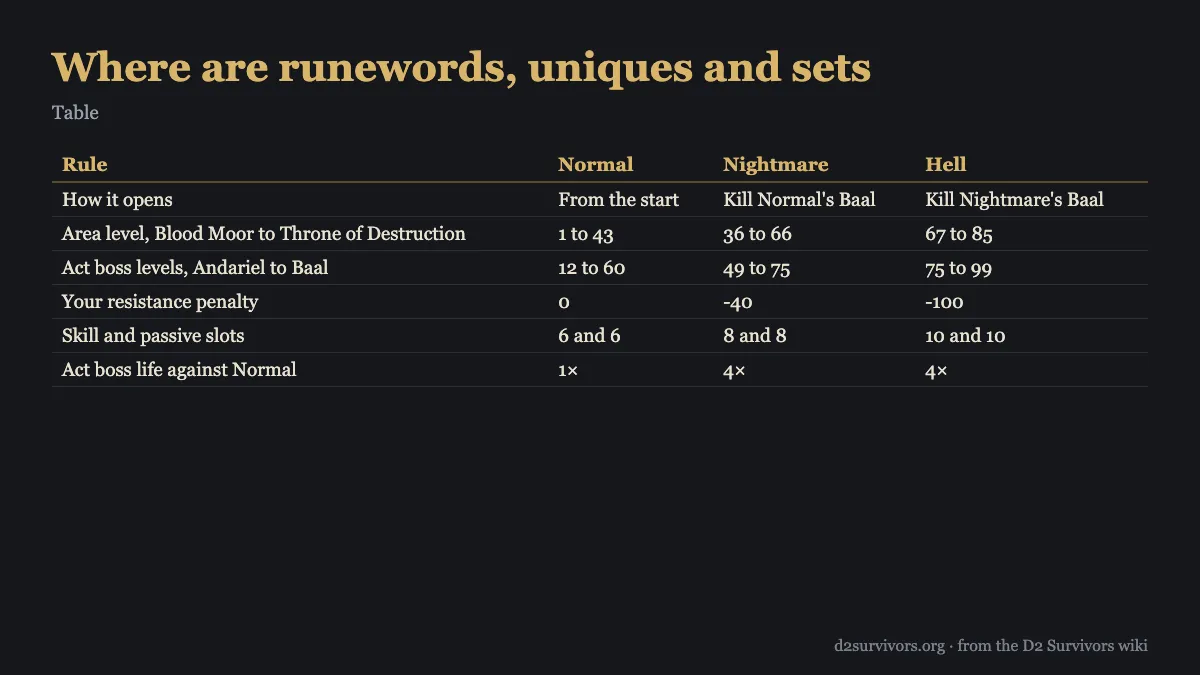
| Rule | Normal | Nightmare | Hell |
|---|---|---|---|
| How it opens | From the start | Kill Normal's Baal | Kill Nightmare's Baal |
| Area level, Blood Moor to Throne of Destruction | 1 to 43 | 36 to 66 | 67 to 85 |
| Act boss levels, Andariel to Baal | 12 to 60 | 49 to 75 | 75 to 99 |
| Your resistance penalty | 0 | -40 | -100 |
| Skill and passive slots | 6 and 6 | 8 and 8 | 10 and 10 |
| Act boss life against Normal | 1× | 4× | 4× |
Changed this build tracks differences from the last release. Check it when a detail seems unfamiliar, then follow the relevant reference for the full rule. The D2 Survivors wiki covers the systems and encounters that shape a run.
How Is a Run Structured?
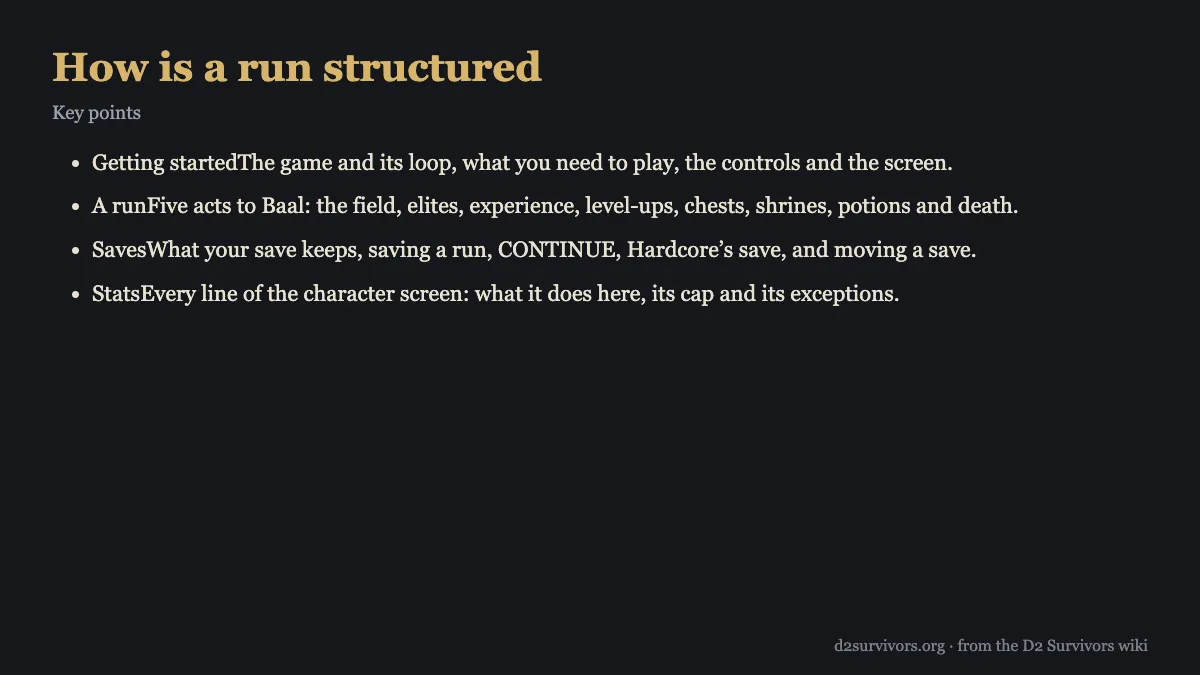
A run follows five acts to Baal, with fields, elites, experience, level-ups, chests, shrines, potions, and death. It begins with no skills and gives a first card for each of your class’s three trees: a first-tier skill or, where needed, a passive.
Choose skills and passives from level-up cards; chests evolve ready skills. Each chest evolves one skill, so a second ready skill waits for the next chest. An evolution takes the base’s slot and is ready to cast at once.
Normal holds 6 skills and passives, Nightmare 8, and Hell 10. Going past Baal adds 2 slots of each kind and offers those picks at once, skills first. Fresh Nightmare and Hell runs start with the added slots. The how to play guide explains the controls and screen.
Skip closes a hand without a pick, ending that level’s choice. Banish removes a skill, passive, attribute, or tree card until the run continues past Baal; banishing a skill’s next level ends its level cards. A banished catalyst prevents its skill from evolving. Akara’s re-draft can offer a ready evolution as its own card.
Kashya offers four mercenary hirelings. Each fights at your level, up to 98, with 2 picks; on Normal, he has half his life, and resurrection costs up to 5,000 gold. Saves and Hardcore explain run saves, CONTINUE, and death.
D2 Survivors Wiki FAQ
Is the D2 Survivors wiki a good place to learn the game?
Yes. Getting started explains the loop, controls, and screen, while A run shows how acts, experience, level-ups, chests, and death fit together.
Where do I find every class’s skills?
Use Skills for each class’s skills, passives, evolutions, and modifiers. Skill systems explains shared card, synergy, recharge, and +skills rules.
Where can I look up runewords, uniques, and sets?
Runewords lists rune combinations and properties, Uniques shows each unique’s picture and item box, and Sets lists pieces and bonuses. Items covers the broader gear systems.
Which guide explains monsters and difficulty changes?
Monsters covers ranks, elite mods, immunities, named enemies, and bosses. Difficulties explains Normal, Nightmare, and Hell, while Terror tiers covers Hell’s endgame waves.
What happens during a run, and when do skills evolve?
You advance through five acts toward Baal, gaining experience and choosing level-up cards as you go. A skill evolves from a chest once it is maxed, its catalyst is held, and the required levels are met.
Which build’s numbers does the D2 Survivors wiki use?
Nightmare and Hell numbers describe a run with your banked hero; an unbanked new hero follows the separate level 1 progression described on the difficulty page. The D2 Survivors wiki reflects the game code as of build 20261105.3 ·583a02f9.
Facts on this page come from the D2 Survivors wiki at d2survivors.lol (game build 20261101.1), read on 2026-11-07. Values can change with later builds.