D2 Survivors Damage: How Hits Scale
Updated 2026-11-07
Version build 20261101.1
D2 Survivors damage comes from a skill or weapon hit, then scales with attributes, skill levels, synergies, and bonuses that apply to its damage type. The monster’s resistance reduces each type separately. Against you, a hit can also be reduced by defense, blocking, damage reduction, resistance, absorb, or defensive skills.
How Is D2 Survivors Damage Calculated?
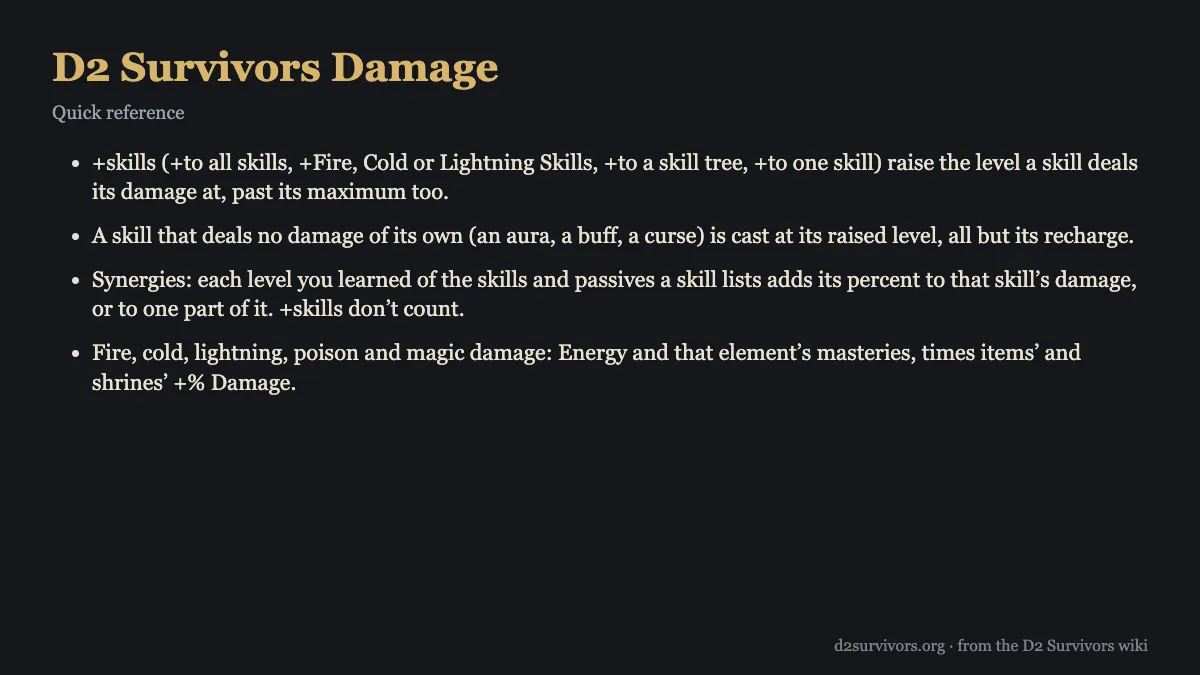
Start with the damage dealt by the skill or weapon blow. Skill levels raise a damaging skill’s own damage, and +skills can take it beyond its listed maximum. Bonuses from +to all skills, an element, a skill tree, or one skill all raise its level. For a skill that deals no damage itself, such as an aura, buff, or curse, +skills raise its cast level too, except for its recharge.
Synergies work differently: each level you learned in a listed skill or passive adds its stated percent to the damage, or to one part of it. +skills do not count as learned levels for this bonus. For physical damage, Strength, physical masteries, and items’ or shrines’ +% Damage feed one bonus; a weapon blow also uses Dexterity and +% Damage to Undead or Demons. Elemental and magic damage scales with Energy and its mastery, multiplied by items’ and shrines’ +% Damage.
A critical strike doubles the physical damage of a qualifying hit. It does not double elements added by items or damage converted to another element, and a hit with no physical damage cannot critically strike. Your attributes determine how Strength, Dexterity, and Energy contribute to your build.
| Field | Value |
|---|---|
| Entries | 6 damage types, 4 ways to lower resistance, 2 resistance caps for you |
| Scope | Damage formula, monster resistances and immunities, and damage taken |
| Data version | Build 20261104.2 · 2b44548b |
| Last updated | 2026-11-05 |
Which D2 Survivors Damage Types Exist?
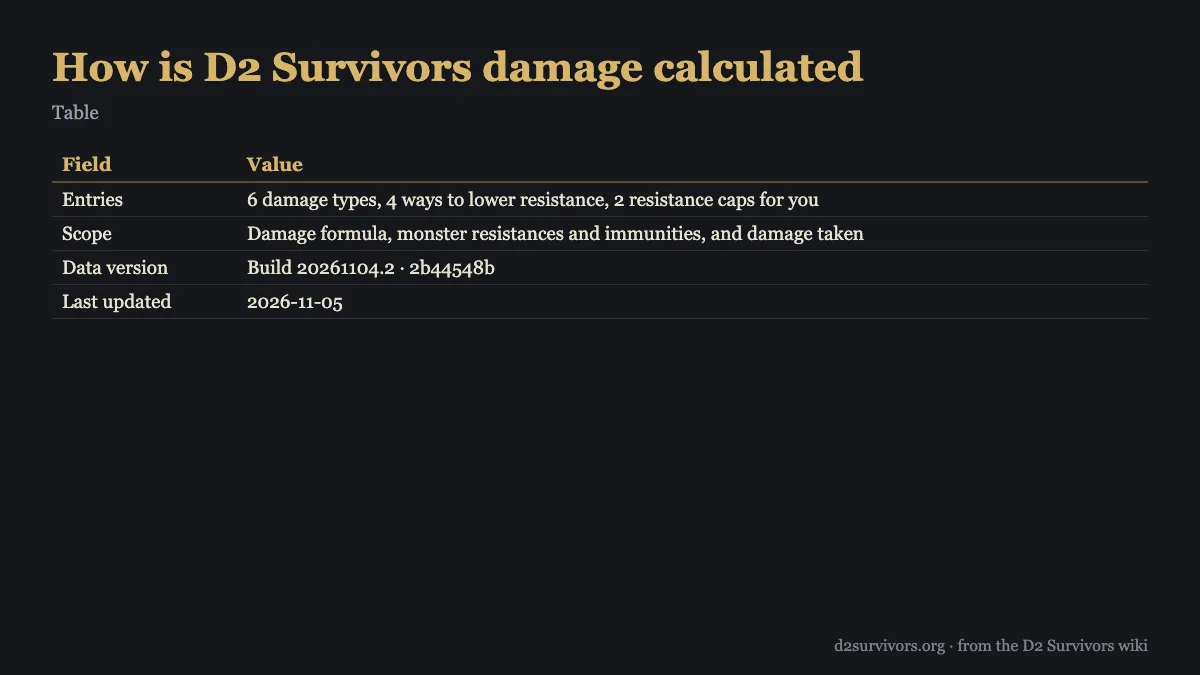
D2 Survivors damage has six types: physical, fire, cold, lightning, poison, and magic. A monster can resist each type separately, so a single hit can deal several kinds of damage and have each part reduced on its own. A weapon’s added fire, cold, lightning, and magic damage does not replace or reduce its physical damage.
A weapon blow carries the elemental and magic damage added by your items. With a weapon in each hand, each weapon’s added damage applies only to blows from that hand. A physical immune can still take the lightning damage on a weapon, and resisting an added element does not reduce the blow’s physical damage, critical strike damage, or life and mana stolen.
Fire Arrow and Cold Arrow add their element to the bow’s physical shot, so an immune monster still takes the physical part. The fire share is thirty-two percent at level 1 and four percent at level 8. Corpse Explosion deals half physical and half fire damage. Cold chills a monster according to its kind’s share; poison deals damage over time and turns the monster green.
| Type | Scales with | Notes |
|---|---|---|
| Physical | Strength, physical masteries, items and shrines; weapon blows also Dexterity | Corpse Explosion is half physical and half fire |
| Fire | Energy, fire mastery, items and shrines | Fire Arrow's shot still hits fire-immune monsters |
| Cold | Energy, cold mastery, items and shrines | Chills slow a monster by its kind's share |
| Lightning | Energy, lightning mastery, items and shrines | A physical-immune monster still takes a weapon's lightning |
| Poison | Energy, poison mastery, items and shrines | Damage over time; the stronger dose and longer time stay |
| Magic | Energy, items and shrines | The snapshot gives no magic-specific resistance rule |
Physical damage has additional rules for critical strikes. A weapon skill’s own blow, arrow, or javelin counts as the weapon’s physical damage even if it deals another element. Some physical spells and summons can critically strike too. For class choices and skill options, see the class guide and build guides.
How Do Resistances Work With D2 Survivors Damage?
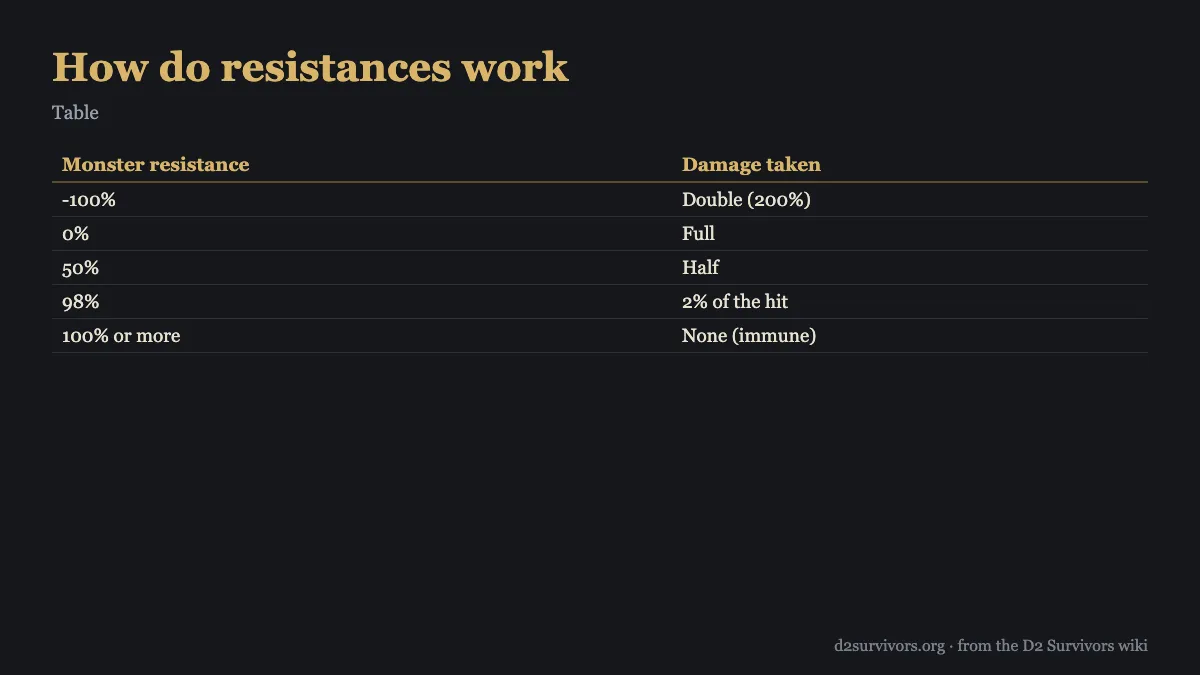
Monsters resist each damage type by a percentage set by their kind and the difficulty. Resistance subtracts that share from incoming damage: at fifty percent resistance, the monster takes half. At one hundred percent or higher, it is immune and takes none of that type, including no chill from cold damage. Resistance cannot fall below minus one hundred percent, where the monster takes double damage.
Champion and unique monster mods can raise their own resistances. Fire Enchanted adds fire resistance, Magic Resistant adds fire, cold, and lightning resistance, and Stone Skin adds physical resistance. In D2 Survivors, a mod does not add resistance to a type that is already at one hundred percent or more, so reducing that resistance can still break the immunity.
Your own defenses resolve hits in a different order. A physical melee blow or missile first rolls to hit against your Defense; a block can turn it aside. Damage Reduced then cuts physical damage, subject to its cap. For fire, cold, lightning, or magic, Magic Damage Reduced removes life damage first, then resistance applies. Absorb can turn part of a fire, cold, or lightning hit into life; Energy Shield takes a share afterward.
| Monster resistance | Damage taken |
|---|---|
| -100% | Double (200%) |
| 0% | Full |
| 50% | Half |
| 98% | 2% of the hit |
| 100% or more | None (immune) |
Your resistances fall by 40 on Nightmare and 100 in Hell and the Terror tiers. Cold resistance also shortens the time you stay chilled or frozen. Poison resistance cuts each second of poison damage, and the difficulty penalty affects Poison Length Reduced. See difficulty details for the settings that shape a run.
How Do You Break Immunities?
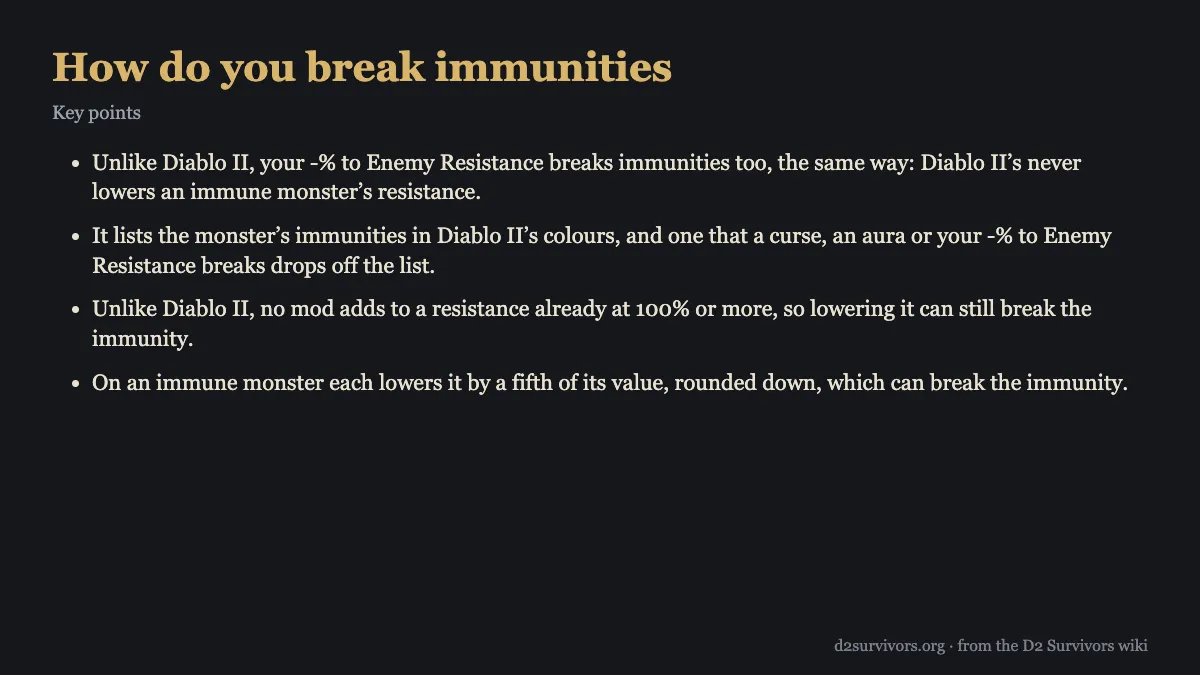
An immunity breaks when resistance-lowering effects bring a monster below one hundred percent. Curses, auras, and Lower Resist are checked against the monster’s own resistance. Each works at full value below one hundred percent, but on an immune monster it works at a fifth of its value, rounded down. Your -% to Enemy Resistance applies after those effects, using the same full or reduced value depending on the remaining resistance.
For example, a monster at one hundred ten percent fire resistance under -fifty percent to Enemy Fire Resistance remains at one hundred percent, so it is still immune. Under -sixty percent, it reaches ninety-eight percent and takes two percent of a fire hit. Unlike Diablo II, your -% to Enemy Resistance can break immunities in this way. The Sorceress’s Fire and Lightning Mastery also lower enemy resistance.
Effects that increase damage taken without lowering resistance do not break an immunity. Battle Cry, Inner Sight, and Cloak of Shadows are examples. A monster immune to an element can still be hurt by another type on a mixed hit, such as the physical part of an arrow or the lightning damage added to a weapon.
Many kinds in Hell are immune to something, and a few are immune in Nightmare. Some unique mods can create an immunity by adding resistance, while a Ghostly champion has eighty percent physical resistance. The act guide can help you prepare for the monsters waiting in each area.
Which Skills and Items Raise Damage Most?
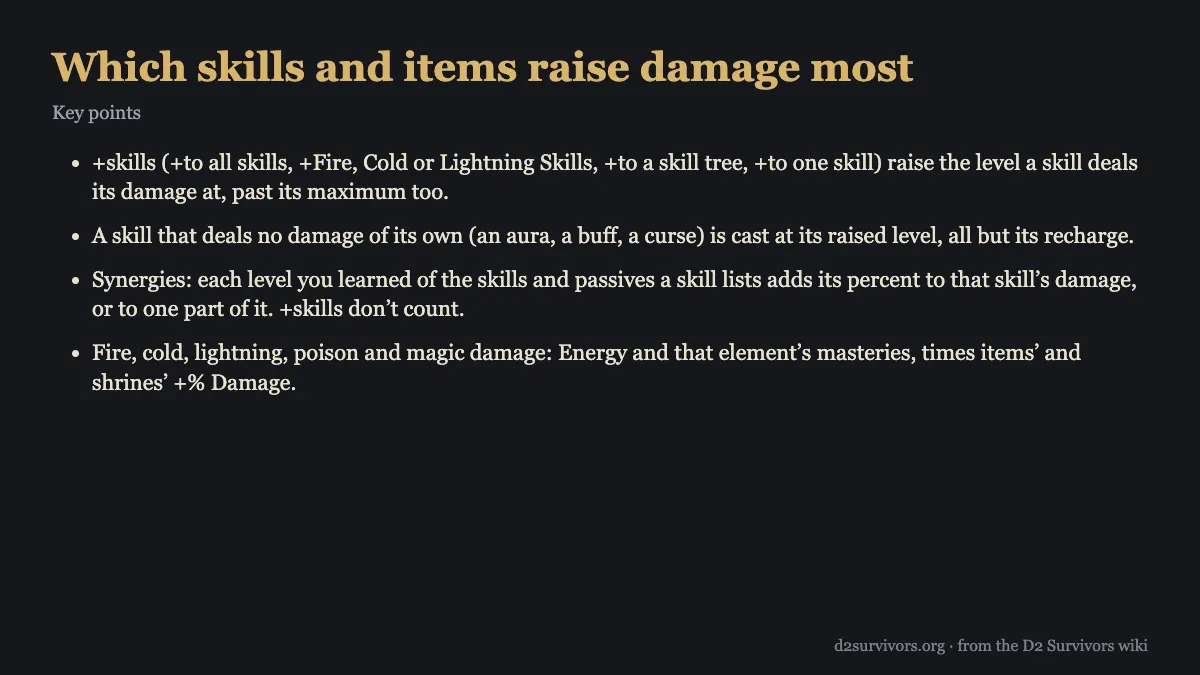
For D2 Survivors damage from skills, +skills raise the level at which a skill deals damage, even past its maximum. Synergies add damage from levels you learned in the listed skills and passives. Check which part of a skill receives its synergy, since a bonus may apply to only one part. Masteries and Energy add elemental or magic damage, while Strength and physical masteries support physical damage.
For weapon blows, items’ and shrines’ +% Damage join the physical bonus alongside Strength and the physical masteries. Dexterity contributes to weapon blow damage according to weapon type: all of its weapon damage bonus applies with a bow, none with an axe, sword, or mace. +% Damage to Undead or Demons also adds to a weapon blow against the matching target.
Critical strike chance is another way to increase physical damage on qualifying hits. Dexterity, Attack Rating, Deadly Strike, and some skills contribute to the chance. The Amazon’s Critical Strike and the Paladin’s Blessed Aim are examples. A critical strike deals twice the hit’s physical damage, while added elemental damage is not doubled.
Items with -% to Enemy Resistance can raise elemental damage against resistant monsters and can help break immunities. Curses, auras, and Lower Resist can do so too, though their effect on an immune monster is reduced. Choose bonuses that support the damage types your build uses; Sorceress builds and Necromancer builds show different routes.
D2 Survivors Damage FAQ
Does +skills raise damage beyond a skill’s maximum level?
Yes. +skills raise the level at which the skill deals damage, even beyond its maximum. Synergies still count only levels you learned in the listed skills and passives.
Can Fire Arrow hurt a fire immune monster?
Yes. Fire Arrow adds fire damage to the bow’s physical shot, so the monster can still take the physical part. Its fire share is smaller at level 8 than at level 1.
Can -% to Enemy Resistance break an immunity?
Yes. It reduces an immune monster’s resistance by a fifth of its value, rounded down. If resistance falls below one hundred percent, the monster takes damage of that type.
Does a critical strike double all damage?
No. A critical strike doubles the physical damage of a qualifying hit. Added elemental damage and damage converted to another element are not doubled.
What raises D2 Survivors damage most for my build?
It depends on whether your damage comes from skills, spells, summons, or weapon blows. D2 Survivors damage can benefit from +skills, learned synergies, attributes, damage bonuses, critical strikes, and resistance reduction.
Facts on this page come from the D2 Survivors wiki at d2survivors.lol (game build 20261101.1), read on 2026-11-07. Values can change with later builds.