D2 Survivors Necromancer: Skills and Playstyle
Updated 2026-11-09
Version build 20261101.1
D2 Survivors necromancer play centers on bone and poison spells, curses that control or weaken monsters, and raised allies that fight beside you. Energy strengthens most of his magic and every summon’s blow, while Poison Dagger and the physical blows of summons benefit from Strength. His three trees offer a mix of direct attacks, support, and minions.
How Does the D2 Survivors Necromancer Play?
The Necromancer brings bone, poison, curses, and the raised dead into a run. Teeth, Corpse Explosion, and other Poison and Bone spells give him attacks, while skeletons, mages, a golem, and revived monsters add summoned fighters. Curses work differently: they deal no damage, instead weakening monsters, turning them, or holding them. See the Necromancer skill trees for the full list.
Energy raises all of his Poison and Bone spells except Poison Dagger, whose stab is physical and raised by Strength. Energy also increases every summon’s blow, while Strength raises the physical blows of summons. Energy gives his spells a stronger increase than other classes receive: each point adds 1.5% to his spells, and 1% to summons and Corpse Explosion.
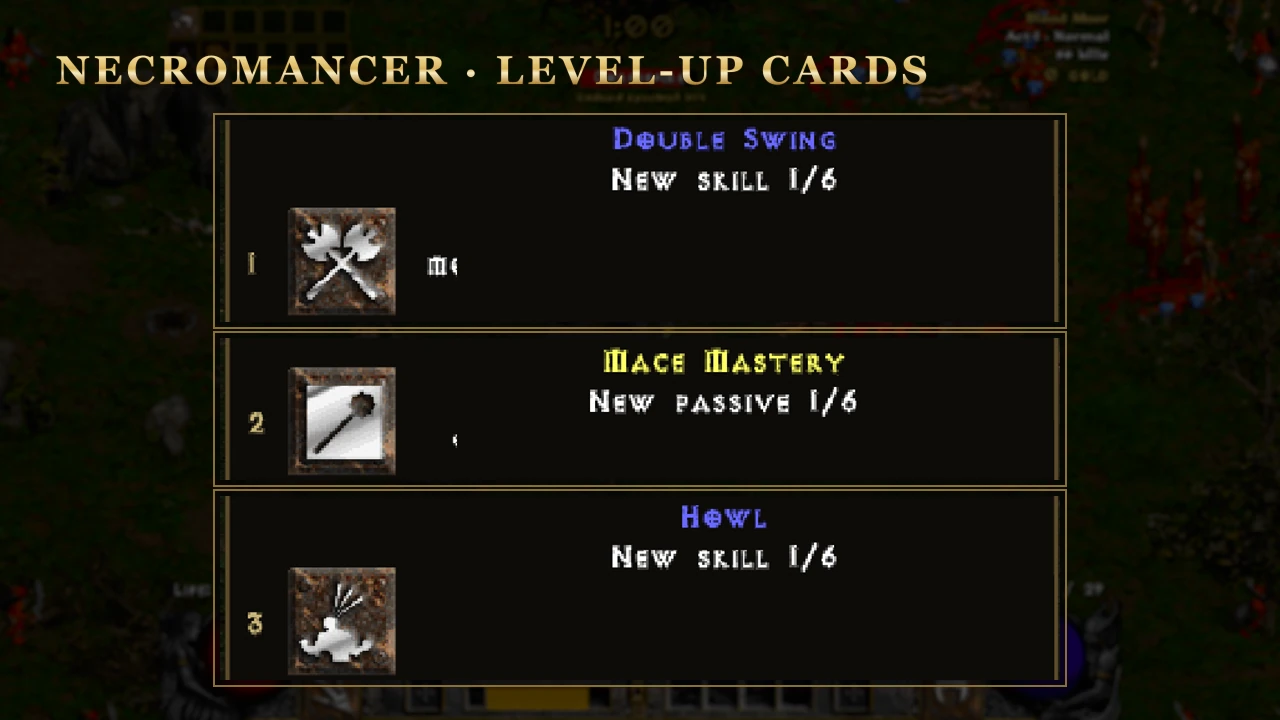
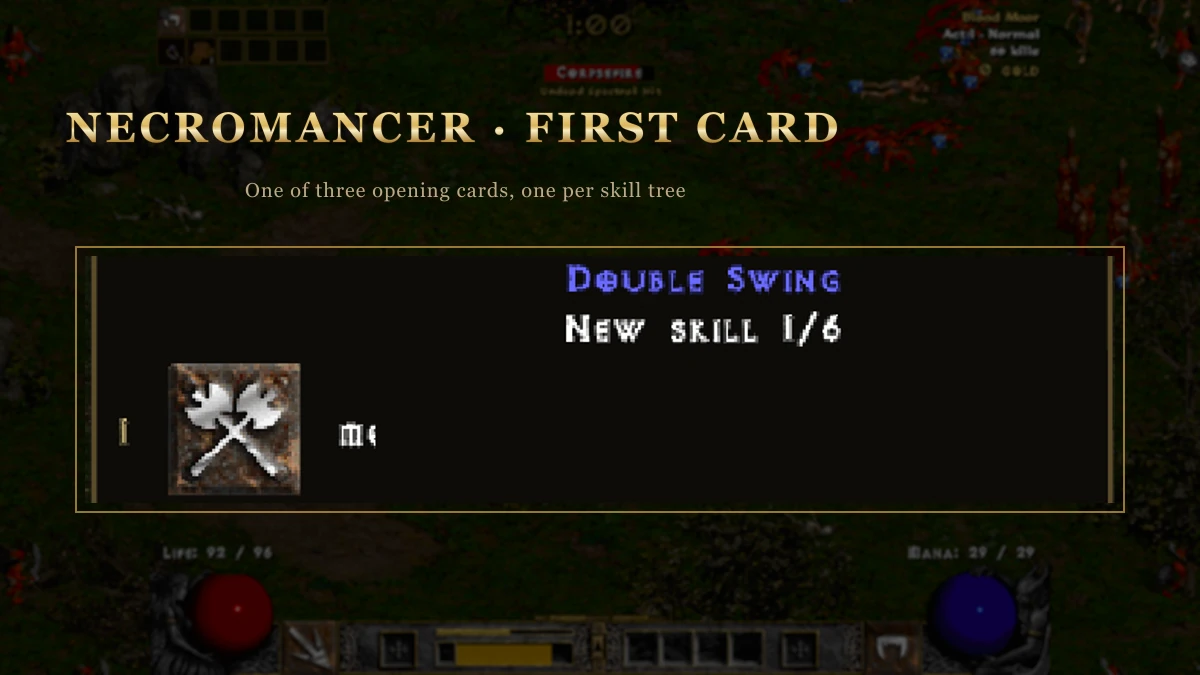
A run’s first card offers one level-1 skill from each tree: Amplify Damage, Teeth, and Raise Skeleton. The D2 Survivors necromancer follows that same opening rule, so the starting choices show his broad mix of curses, attacks, and summons. A curse appears on level-up cards 40% as often as other skills, which makes its availability worth keeping in mind as you plan a run.
What Skill Trees Does the Necromancer Have?
The Necromancer has three skill trees, with 30 entries in total and 11 evolutions. Curses focus on effects that disrupt or weaken monsters. Poison and Bone Skills mix spell attacks with passive defenses. Summoning Skills raise allies and include passives that support the summons. These groups give you distinct roles to consider while choosing the skills for a run. Browse the skill guide for more skill references.
The first level-1 card offers one skill from each tree: Amplify Damage from Curses, Teeth from Poison and Bone Skills, and Raise Skeleton from Summoning Skills. Bone Armor, Skeleton Mastery, and the other passives also have their own unlock levels in the lists. Skill and passive capacity depends on difficulty: Normal allows 6 of each, Nightmare 8, and Hell 10.
| Tree | Entries | Evolutions | First skills (level 1) |
|---|---|---|---|
| Curses | 10 | 3 | Amplify Damage |
| Poison and Bone Skills | 10 | 4 | Teeth, Bone Armor |
| Summoning Skills | 10 | 4 | Raise Skeleton, Skeleton Mastery |
When choosing among the trees, consider the role each skill fills. Curses change how monsters behave or how vulnerable they are. Poison and Bone offers spell attacks and passive options, while Summoning builds a group of raised fighters. The D2 Survivors necromancer can draw from all three trees, but the number of skill and passive slots available depends on difficulty.
At What Level Do D2 Survivors Necromancer Skills Open?
A skill opens at its required level. After it opens, each additional level waits one more character level. That makes the unlock level the earliest point to see a skill offered, while later levels govern its next opportunities. The tables list the required level and maximum level for every entry, including the passive skills. For how attributes affect skills, see the attributes guide.
The level-1 skills include Amplify Damage, Teeth, Raise Skeleton, Bone Armor, and Skeleton Mastery. New active options arrive at level 6, including Dim Vision, Weaken, Corpse Explosion, Poison Dagger, and Clay Golem. Level 12 adds Iron Maiden, Terror, Raise Skeletal Mage, and Bone Wall, among others. The full lists show the unlocks tree by tree.
| Skill | Type | Opens at level | Max level |
|---|---|---|---|
| Amplify Damage | Skill | 1 | 8 |
| Dim Vision | Skill | 6 | 8 |
| Weaken | Skill | 6 | 8 |
| Iron Maiden | Skill | 12 | 8 |
| Terror | Skill | 12 | 8 |
| Confuse | Evolution | 18 | 1 |
| Life Tap | Skill | 18 | 8 |
| Attract | Evolution | 24 | 1 |
| Decrepify | Evolution | 24 | 1 |
| Lower Resist | Passive | 30 | 5 |
| Skill | Type | Opens at level | Max level |
|---|---|---|---|
| Teeth | Skill | 1 | 8 |
| Corpse Explosion | Skill | 6 | 8 |
| Poison Dagger | Skill | 6 | 8 |
| Bone Spear | Evolution | 18 | 1 |
| Poison Explosion | Evolution | 18 | 1 |
| Bone Prison | Skill | 24 | 8 |
| Bone Spirit | Evolution | 30 | 1 |
| Poison Nova | Evolution | 30 | 1 |
| Bone Armor | Passive | 1 | 5 |
| Bone Wall | Passive | 12 | 5 |
| Skill | Type | Opens at level | Max level |
|---|---|---|---|
| Raise Skeleton | Skill | 1 | 8 |
| Clay Golem | Skill | 6 | 8 |
| Raise Skeletal Mage | Skill | 12 | 8 |
| Blood Golem | Evolution | 18 | 1 |
| Iron Golem | Evolution | 24 | 1 |
| Fire Golem | Evolution | 30 | 1 |
| Revive | Evolution | 30 | 1 |
| Skeleton Mastery | Passive | 1 | 5 |
| Golem Mastery | Passive | 12 | 5 |
| Summon Resist | Passive | 24 | 5 |
For a D2 Survivors necromancer run, check the required level before building around a later skill. Confuse and several other evolutions open at level 18, while some choices do not open until level 30. The maximum-level column also distinguishes skills with several ranks from evolutions and passives with a lower cap.
Which Necromancer Skills Evolve, and When?
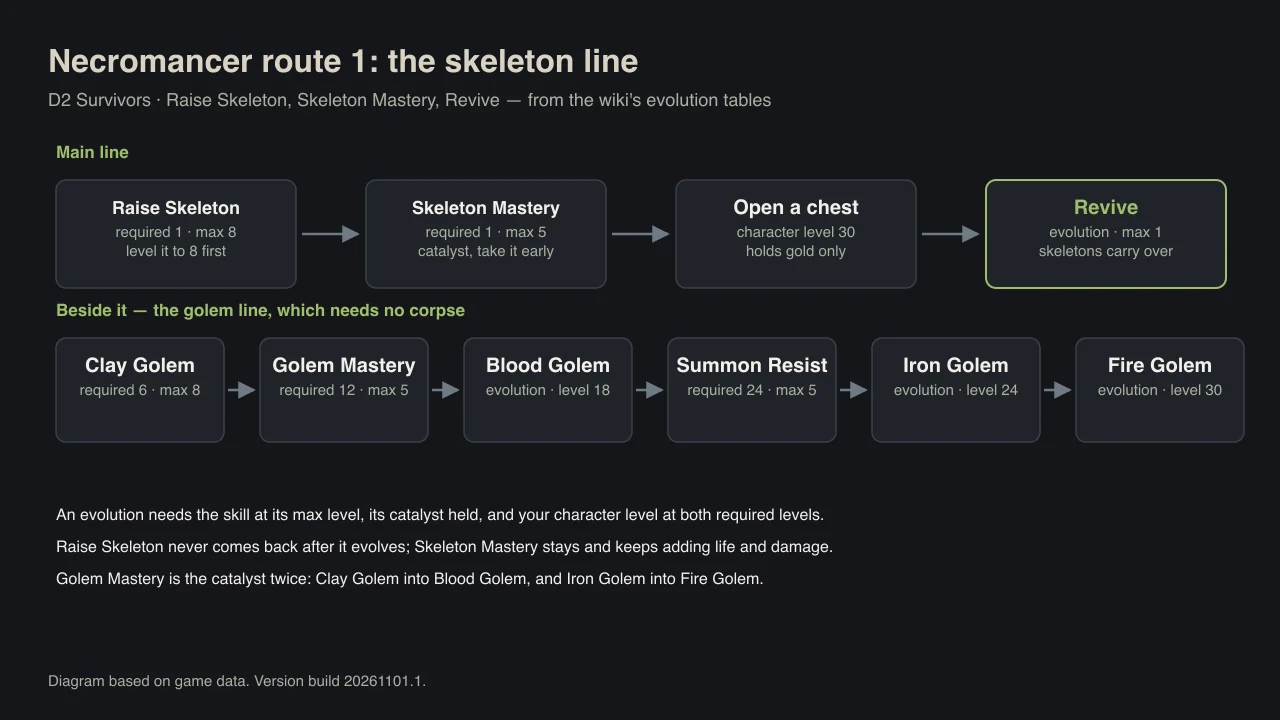
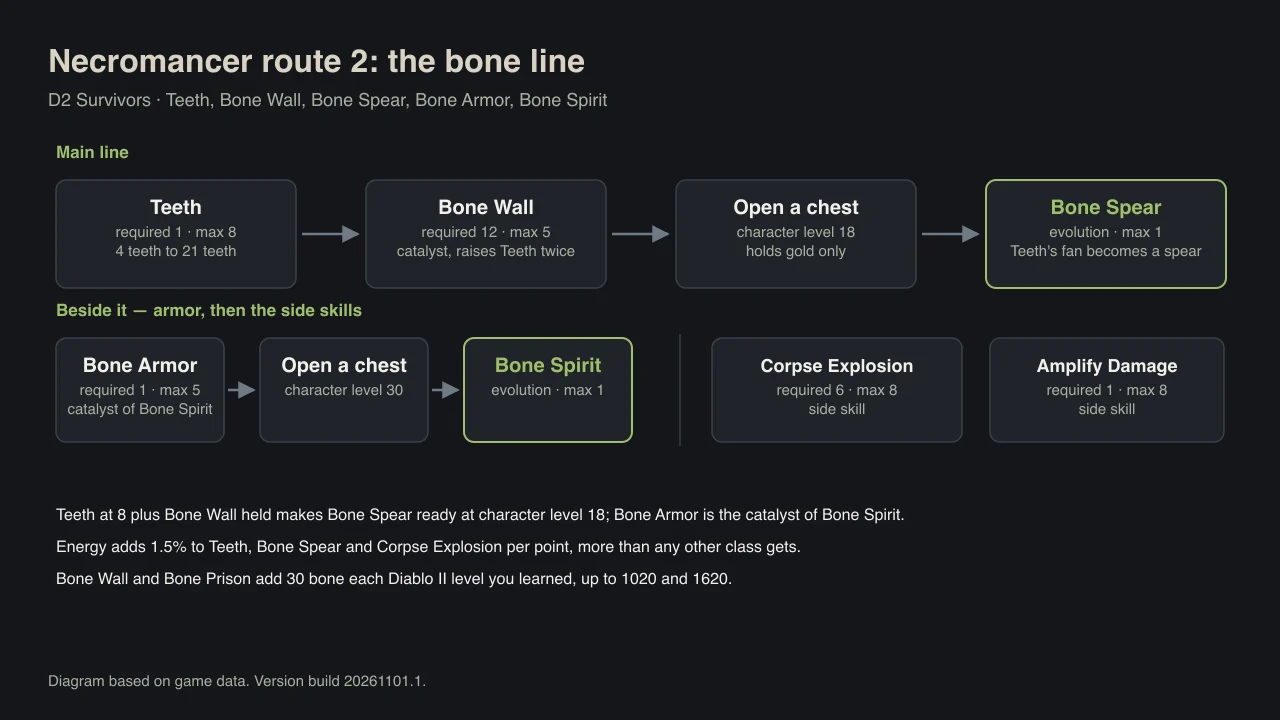
The Necromancer has 11 evolutions across his three trees. In Curses, Confuse opens at level 18, followed by Attract and Decrepify at level 24. Poison and Bone Skills add Bone Spear and Poison Explosion at level 18, then Bone Spirit and Poison Nova at level 30.
Summoning Skills add Blood Golem at level 18, Iron Golem at level 24, and Fire Golem and Revive at level 30. Each evolution has a maximum level of 1. The lists above mark these entries as Evolutions, so you can distinguish them from skills that open at the same level.
Because an evolution opens at its required level, its timing matters when you have a particular one in mind. Level 18 brings options in every tree; level 24 adds options in Curses and Summoning; and level 30 brings the later Poison and Bone and Summoning evolutions. Keep the level-up rule in view: after a skill opens, each next level waits one additional character level.
Is the Necromancer Good for Beginners in D2 Survivors?
The Necromancer gives a new player several ways to approach a run: cast bone or poison spells, use curses to affect monsters, or raise allies to fight. The D2 Survivors necromancer also has a clear level-1 choice from each tree on the first card, so the opening introduces his three main skill groups directly.
His damage scaling has a few details to learn. Energy raises his spells, every summon’s blow, and Corpse Explosion, with a smaller increase for summons and Corpse Explosion than for spells. Poison Dagger’s stab instead scales with Strength, as do summons’ physical blows. Curses deal no damage, and each appears on level-up cards 40% as often as other skills.
Those differences make the class approachable if you like choosing between attacks, support, and summoned allies, while still giving you details to track as you build. Start by learning which tree a skill belongs to and when it opens. The three trees and their tables provide a quick reference as your available skill and passive slots change with difficulty.
D2 Survivors Necromancer FAQ
Does the Necromancer start with a special first card?
No. The first card offers one level-1 skill from each tree: Amplify Damage, Teeth, and Raise Skeleton. The Necromancer follows that same rule.
Which Necromancer skill benefits from Strength?
Poison Dagger’s stab is physical, so Strength raises it. Strength also raises the physical blows of summons.
Do Necromancer curses deal damage?
No. Curses weaken monsters, turn them, or hold them. Each curse is offered on level-up cards 40% as often as other skills.
How many skills and passives can I hold in a run?
Normal allows 6 skills and 6 passives, Nightmare allows 8 of each, and Hell allows 10 of each. The available slots depend on difficulty.
Is the D2 Survivors necromancer a good beginner class?
He offers spells, curses, and summons, with one level-1 choice from each tree on the first card. Learning how each skill scales helps you make informed choices as the run progresses.
Data: the official D2 Survivors wiki (d2survivors.lol), Necromancer skill pages, checked 2026-11-02.