D2 Survivors Skills: Cards And Growth
Updated 2026-11-07
Version build 20261101.1
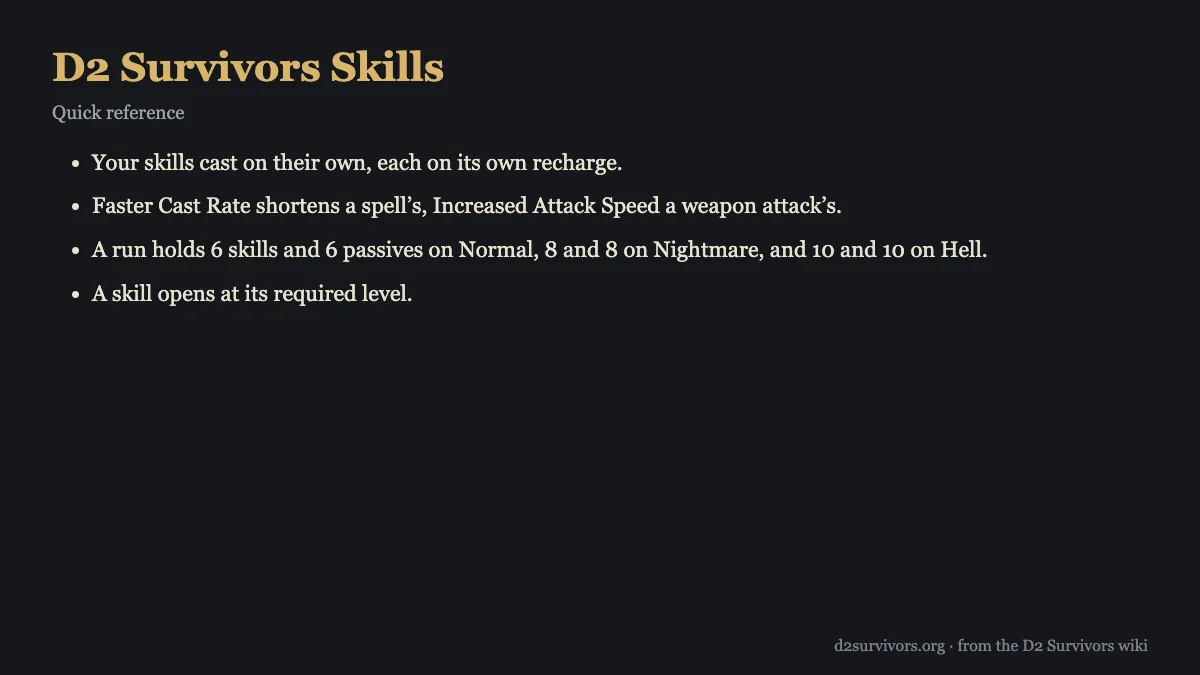
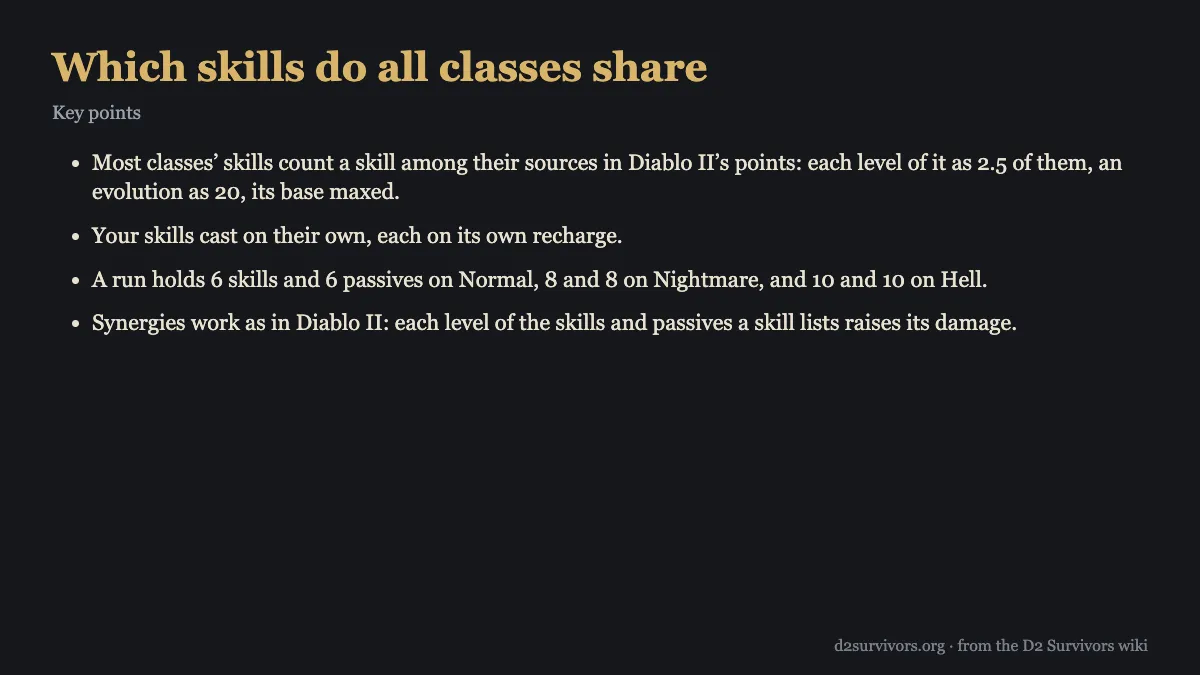
D2 Survivors skills cast automatically, each on its own recharge. A run can hold 6 skills and 6 passives on Normal, 8 of each on Nightmare, or 10 of each on Hell. Level-up cards add skills and passives, while chests turn eligible skills into evolutions; character level and your choices shape both.
How many D2 Survivors skills are there?
The game has class skill trees, with skills and passives arranged by required character level. Every skill and passive belongs to a tier at level 1, 6, 12, 18, 24, or 30, following Diablo II where it has that skill. An evolution sits one tier above its base skill. A run’s skill capacity depends on difficulty: Normal holds 6, Nightmare 8, and Hell 10, with the same number of passive slots.
A new run begins with no skills. Its first card arrives at once and offers one first tier skill from each of your class’s three trees. If a tree has two first tier damage skills, one is chosen at random. The Paladin’s Blessed Hammer and the Barbarian’s Double Swing open at level 1 as first cards. D2 Survivors skills are arranged across the three trees; see the class guide for details.
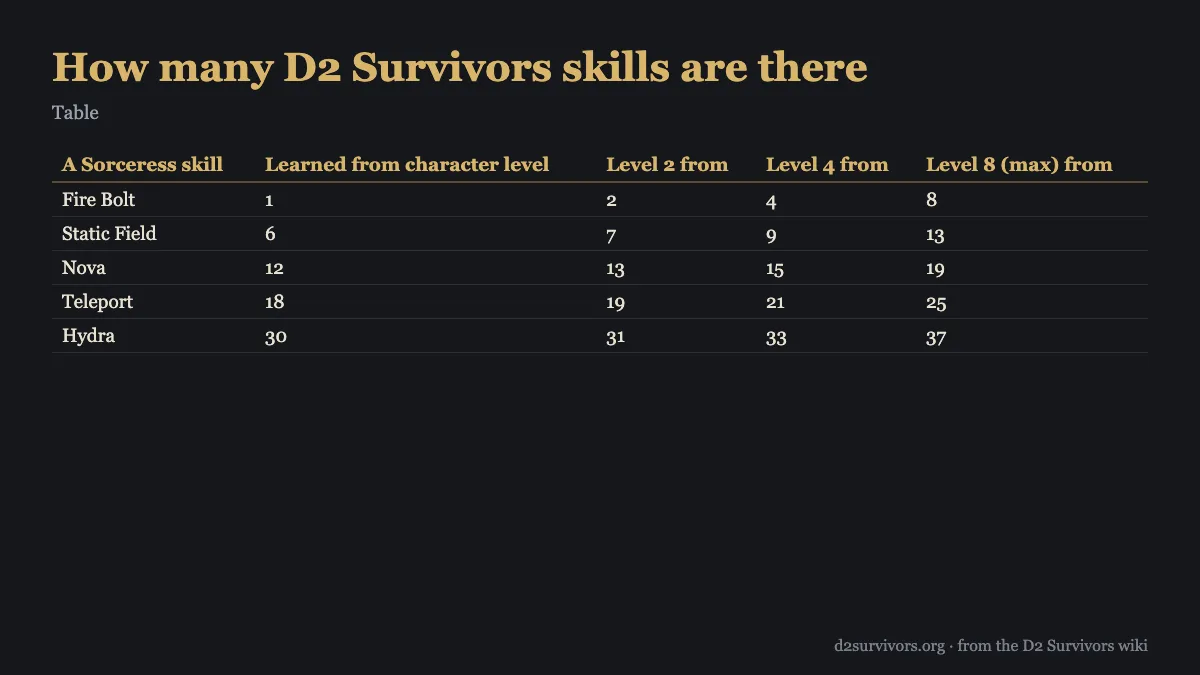
| A Sorceress skill | Learned from character level | Level 2 from | Level 4 from | Level 8 (max) from |
|---|---|---|---|---|
| Fire Bolt | 1 | 2 | 4 | 8 |
| Static Field | 6 | 7 | 9 | 13 |
| Nova | 12 | 13 | 15 | 19 |
| Teleport | 18 | 19 | 21 | 25 |
| Hydra | 30 | 31 | 33 | 37 |
How do skill cards come up in a run?
After the opening choice, level-up hands can offer the next level of a skill or passive you already hold, up to the level your character allows. They can also offer a new skill or passive when its kind has a free slot. Cards that lead to an evolution appear more often: a needed catalyst passive and each further level of a skill that can still evolve. D2 Survivors skills that can evolve draw more level cards once you hold their catalyst. Necromancer curses deal no damage on their own, so they appear less often.
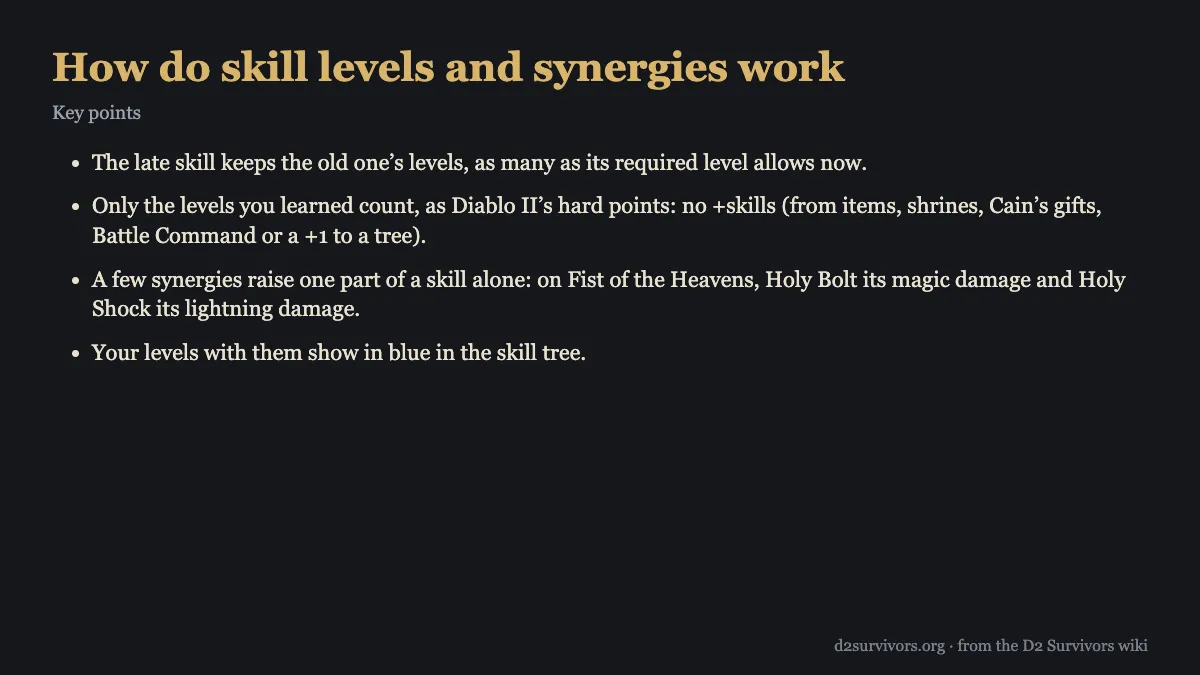
The last free passive slots are held for catalysts your skills still need. If you pass over an opened catalyst for a few character levels, its slot returns to the other passives. With all skill slots full, a late skill requiring level 18 or more can replace an early skill from its tree. It cannot replace an evolution or a skill whose catalyst you hold. The late skill inherits as many levels as its required level currently allows.
Skip closes the hand without a pick, and that level’s choice is lost. Banish removes any skill, passive, attribute, or tree card until you continue past Baal into the next difficulty. Banishing a next level ends that skill’s future level cards; banishing a catalyst blocks its evolution. The tree marks banished entries with a red X. On continuing past Baal, you gain 2 skill and 2 passive slots, with extra picks arriving as new skills first, then new passives. A fresh Nightmare or Hell run starts with those slots.
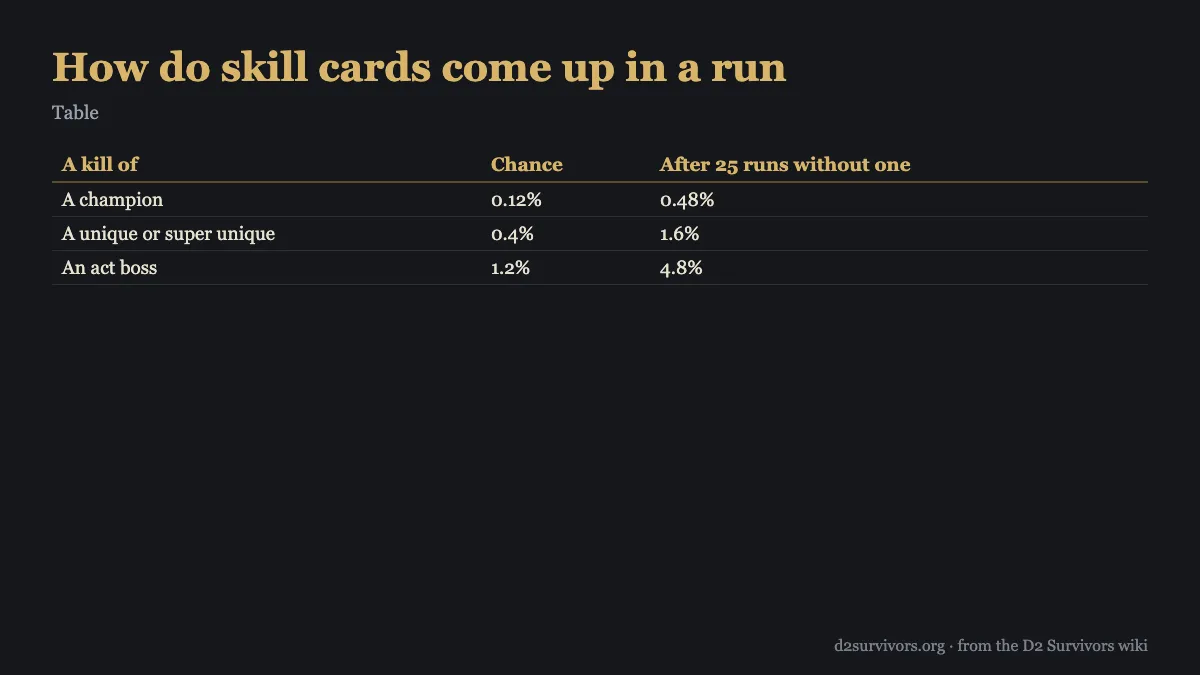
| A kill of | Chance | After 25 runs without one |
|---|---|---|
| A champion | 0.12% | 0.48% |
| A unique or super unique | 0.4% | 1.6% |
| An act boss | 1.2% | 4.8% |
How do D2 Survivors skills evolve?
A skill is ready to evolve when it has reached its maximum level, you hold its catalyst passive, and your character level meets both the evolution’s requirement and the catalyst’s. The next chest you open turns one ready skill into its evolution. Chests evolve one skill at a time; if two are ready, the following chest handles the other. Evolutions come from chests, never from ordinary level-up cards.
An evolution takes the base skill’s slot, has one level, and is ready to cast immediately; a rested skill remains rested. Some evolutions evolve again. Fire Bolt becomes Fire Ball with Warmth from character level 12, then Fire Ball becomes Meteor with Enchant from level 24. Each evolution is already at its maximum, so it waits only for its own catalyst and level. A held catalyst can ready several skills, each for its own chest.
Once a skill evolves, its base can return to level-up cards as a new level 1 skill in its own slot. A base held beside its evolution cannot evolve until that evolution evolves onward. Some bases never return because the evolution carries their pack, armor, curse, or form. Examples include Raise Skeleton, Clay Golem, Shout, Holy Shield, Frozen Armor, Raven, Oak Sage, Werewolf, and Werebear. A point spent on the base stays there; move it to the evolution’s own options to affect that skill. Akara’s re-draft can offer an evolution as a card; banishing it there keeps it unavailable until your next re-draft.
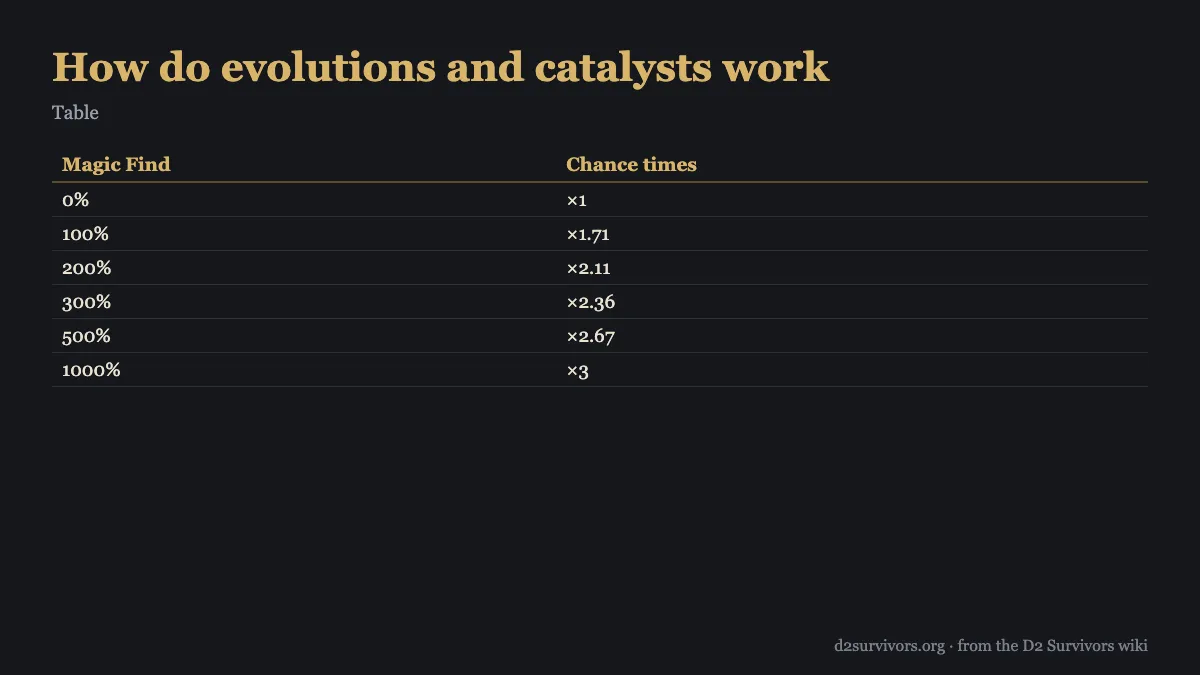
| Magic Find | Chance times |
|---|---|
| 0% | ×1 |
| 100% | ×1.71 |
| 200% | ×2.11 |
| 300% | ×2.36 |
| 500% | ×2.67 |
| 1000% | ×3 |
Which skills do all classes share?
The shared skills are passives, and every class’s shared passives open at character level 1. A new passive can appear while a passive slot is free, and a hand can offer its next level when your character level allows it. Passives can also serve as catalysts, enabling eligible skills to evolve.
Skill modifiers are separate choices for each skill: most skills and auras have two or three options. A Horadric Codex grants one point, up to 10 per class. Each point activates one option on one skill, and applies in every run that holds that skill. You can move a point to another skill or option from the skill window at any time. Codices drop from Normal onward, mostly from elites and act bosses, at most once per run. Magic Find raises the chance, and each run without a drop slightly raises the next run’s chance.
In a hand with fewer than three cards open, stat points and +1 to a tree fill the space. A tree bonus raises every skill and passive you hold in that tree, even past its maximum level, and can appear at most 3 times per tree in a run. D2 Survivors skills and class details are covered in the Sorceress guide and class builds. Level-ups, their keys, and stat points are covered in A run.
How do skill levels and synergies work?
A skill opens at its required level, then each new level takes one more character level. A skill that opens at 12 can reach level 3 at character level 14. Skills reach level 8, evolutions have 1 level, and passives reach level 5. The level cap follows the Diablo II rule: character level minus the skill’s requirement plus one. If a level is waiting on your character, the hand names the level needed, such as “Nova: next level at character level 14.”
Synergies increase damage based on the levels of skills and passives listed as sources. D2 Survivors skills use half of Diablo II’s synergy percentage per source level, rounded to a whole percent and at least one percent. Fire Ball gains eighteen percent per Fire Bolt level, compared with Diablo II’s fourteen percent. Class passives among a skill’s sources count each of their 5 levels as 4 Diablo II points; Blessed Hammer gains twenty-eight percent per Vigor level. Learned levels count as hard points, so item bonuses and other +skills do not count as synergy levels.
Most classes count each level of a listed skill source as 2.5 Diablo II points; an evolution counts as 20, with its base at maximum. Meteor gains six percent per Fire Bolt level and fifty percent for Fire Ball. Evolutions keep their base’s synergies, including synergies inherited from the base’s base. A skill learned again beside its own evolution counts that evolution as a synergy, except for Amazon and Barbarian skills. For damage and item bonuses, see the attributes guide.
Faster Cast Rate shortens spell recharges; Increased Attack Speed shortens weapon attack recharges. Skill bonuses can raise damage, but a damaging skill keeps its learned level for recharge, number of attacks, reach, and duration. No +skill shortens a skill’s own recharge. Your class passives can exceed their maximum through +skills, while a +1 to a tree raises all skills and passives you hold in that tree. A skill’s levels appear in blue in the tree.
D2 Survivors Skills FAQ
Do skills cast automatically?
Yes. Each skill casts on its own recharge. Faster Cast Rate shortens spell recharges, while Increased Attack Speed shortens weapon attack recharges.
Can I evolve a skill from a level-up card?
No. Evolutions come from chests once the skill is maxed, its catalyst is held, and both required character levels are reached. A chest evolves one ready skill.
What happens if I banish a catalyst?
That catalyst cannot be taken during the run, so the skill cannot evolve until you continue past Baal and clear your banishes. The skill tree marks the banished passive with a red X.
Do item bonuses count toward synergies?
No. Synergies count learned levels of their listed sources, not +skills from items, shrines, Cain’s gifts, Battle Command, or a tree bonus. Item bonuses can still raise skill levels and damage.
How do D2 Survivors skills gain levels?
A skill’s first level opens at its required character level, and each later level waits one more character level. The level cap is character level minus the requirement plus one; D2 Survivors skills use learned source levels to raise damage through synergies.
Facts on this page come from the D2 Survivors wiki at d2survivors.lol (game build 20261101.1), read on 2026-11-07. Values can change with later builds.